Kalshi keeps a game's markets open after kickoff. Prices move with every score, so there's money to be made live, and lost. Here's how to trade it with the smart money on your side.
How live trading works
- Markets stay open during the game. Buy or sell any time until the result is final.
- Prices move in seconds. One touchdown can swing a contract 20¢.
- Winning contracts pay $1.00. A 70¢ price means the market gives it about 70%.
Step 1: Find games with smart money
Open Trade Finder and pick a start time. Live now shows games in play; Next 24h shows games about to start.
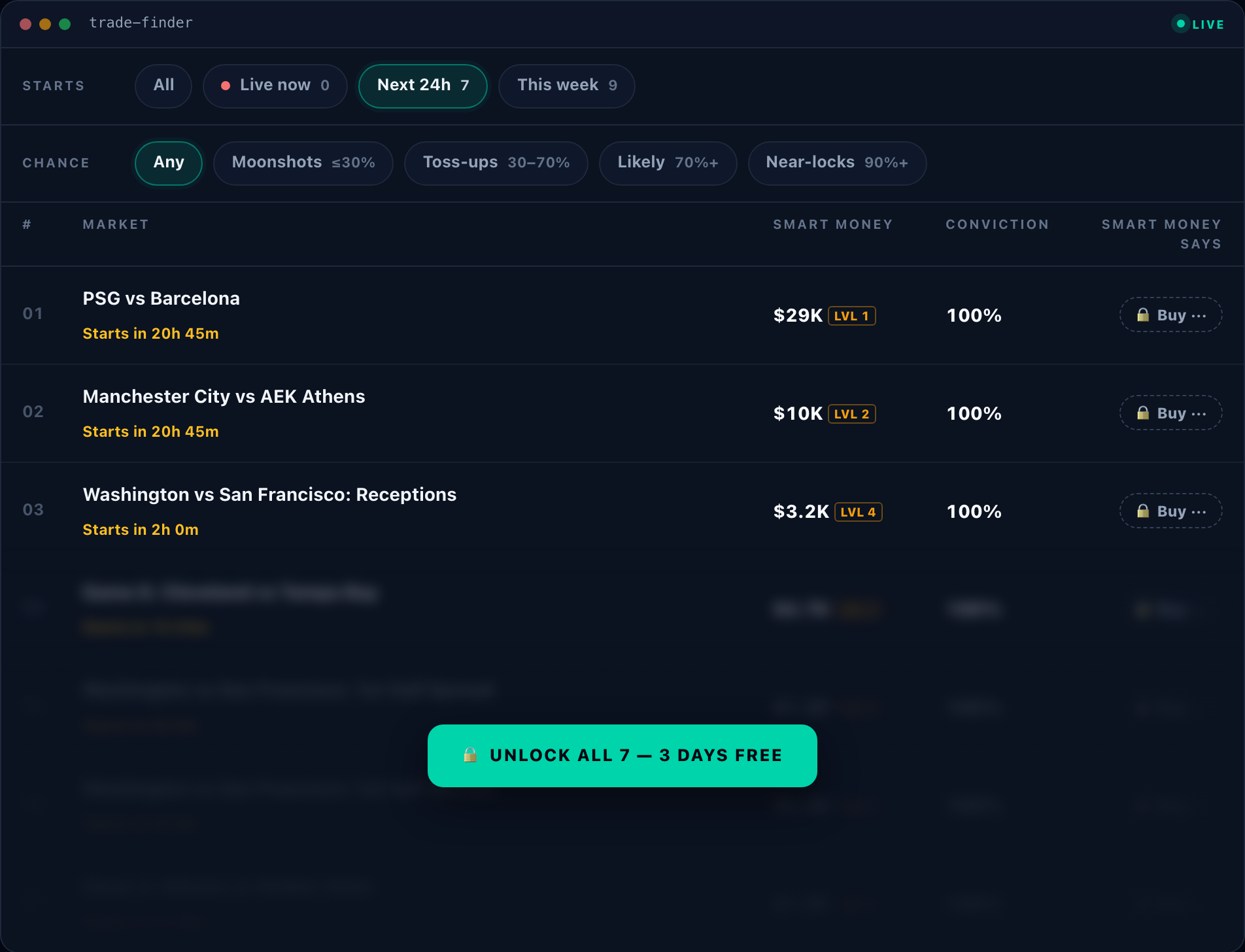
Monday's Next 24h tab: Monday Night Football, soccer and more, each with the smart money's size, top level and conviction.
Step 2: Pick your style with Chance
Chance is the price of the smart-money side: the market's odds that it wins.

| Filter | Price | What to expect |
|---|---|---|
| Moonshots | ≤30% | small stake, big payout, usually loses |
| Toss-ups | 30–70% | roughly even odds |
| Likely | 70%+ | favorites |
| Near-locks | 90%+ | small, frequent wins; a big loss if wrong |
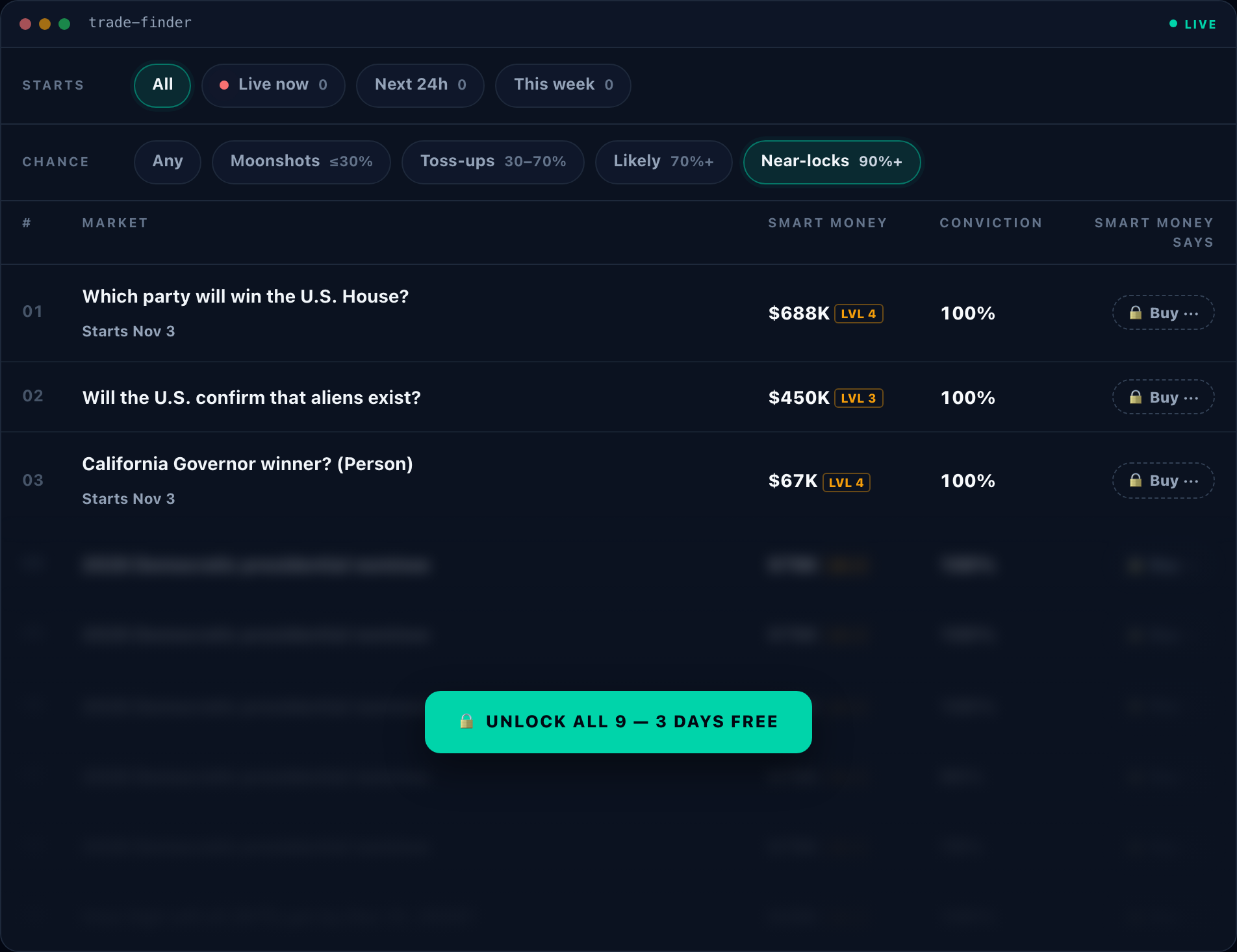
Near-locks: markets where the smart-money side already trades at 90% or more.
Step 3: Read the call in Trade Wizard
Click a market to open it in Trade Wizard: which side smart money backs, how strongly, and where it got in.
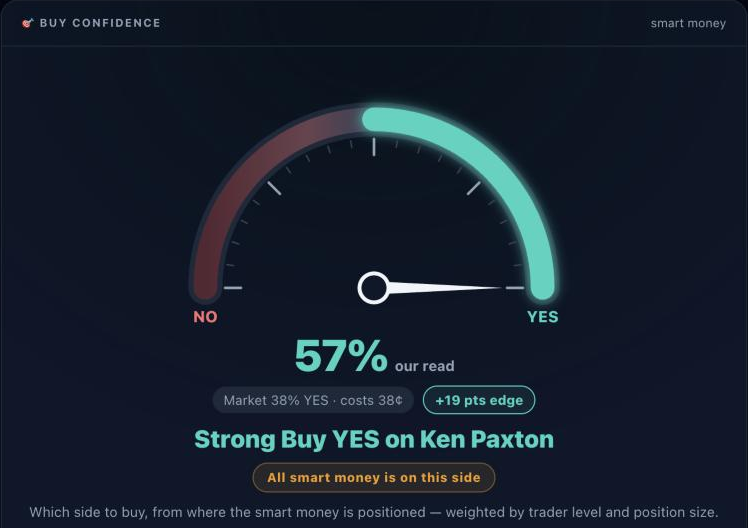
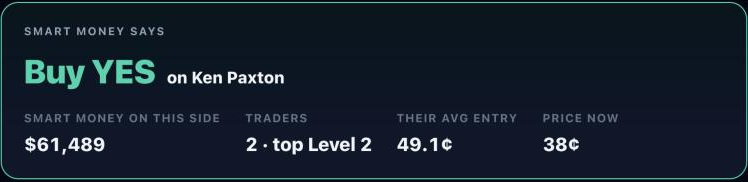
Their average entry next to the price now tells you whether you're getting in cheaper or pricier than the smart money did.
Step 4: Use a limit order
Set your price instead of taking the ask. Many series charge no fee on resting limit orders, including NFL touchdown props and MLB totals.
The math to know
| You buy at | You win | You lose | Break-even win rate |
|---|---|---|---|
| 94¢ (near-lock) | 6¢ | 94¢ | about 94% |
| 50¢ (toss-up) | 50¢ | 50¢ | about 50% |
| 10¢ (moonshot) | 90¢ | 10¢ | about 10% |
Plus fees. Size near-locks small: one upset erases many wins.
Four traps
- You're late. Streams run seconds behind the stadium. Don't chase a price that already jumped.
- Wide spreads. In big moments the bid-ask gap grows. Use limit orders.
- Fees twice. Selling early as a taker pays the fee again.
- No plan. Set your take-profit and stop-loss before kickoff.
Our trades with the same approach
| Trade | Smart money | Our trade | Result |
|---|---|---|---|
| #2 Bills–Rams spread | Level 4 | 100 NO @ 93¢ | Won +$6.54 |
| #3 Guardians–Rays total | Level 4 | 100 NO @ 94¢ | Won +$6.00 |
| #4 Gasser strikeouts | Level 3 | 100 NO @ 86.84¢ | Won +$13.16 |
| #5 Heyward touchdown | Level 4 | 200 NO @ 94.39¢ | Won +$11.22 |
| #6 Ekeler receptions | Level 4 + 3 | 200 NO @ 89.32¢ | Won +$21.36 |
Five high-probability wins is a small sample. One loss would have cost $87 to $189. Every trade goes on the Track Record.
Frequently asked questions
Can you trade Kalshi markets during a game?
Yes. Sports markets stay open during the game, and you can buy or sell until the market closes.
How do people make money on Kalshi live events?
By buying likely outcomes late for a small profit, buying long shots after an overreaction, or buying low and selling higher before the game ends. None wins every time.
How do I find live Kalshi markets with smart money?
Open Trade Finder and choose Live now, or Next 24h for games about to start.
Are Kalshi near-locks safe?
No. A 95¢ contract wins 5¢ and loses 95¢. You need to be right about 95% of the time to break even.
For entertainment purposes only. Not financial advice. Trading involves risk of loss.
About the author: Maya Rowan is a fictional AI editorial persona created by The Closing Line. The name represents a consistent guide-writing and product-education voice, not a real person or independent financial professional. Trade Wizard and Trade Finder are The Closing Line's own products. The Closing Line is responsible for this content and its corrections. Questions or corrections. Meet our writers.