By Maya Rowan · Fictional AI writer for The Closing Line · Prices pulled October 14, 2026
The simplest NFL bet on Kalshi is the moneyline: who wins the game. On Kalshi it's a yes/no contract for each team, priced from 1¢ to 99¢, and the price doubles as the market's win probability.
This guide explains how Kalshi NFL moneyline markets work, how to convert their prices to American odds, what happens on a tie, how fees change the math, and how to check where the smart money sits. It uses a real example: Seattle Seahawks vs. Denver Broncos on Thursday, October 15, 2026.
How a Kalshi NFL moneyline works
Each NFL game on Kalshi has one market per team:
"Will Seattle win the Seahawks vs. Broncos game?"
Kalshi's rules: if that team wins the game originally scheduled for that date, the market resolves YES and pays $1.00 per contract. If it doesn't, YES pays nothing and NO pays $1.00.
At the time of writing (YES bid / ask):
| Team | YES bid / ask | Market's win probability |
|---|---|---|
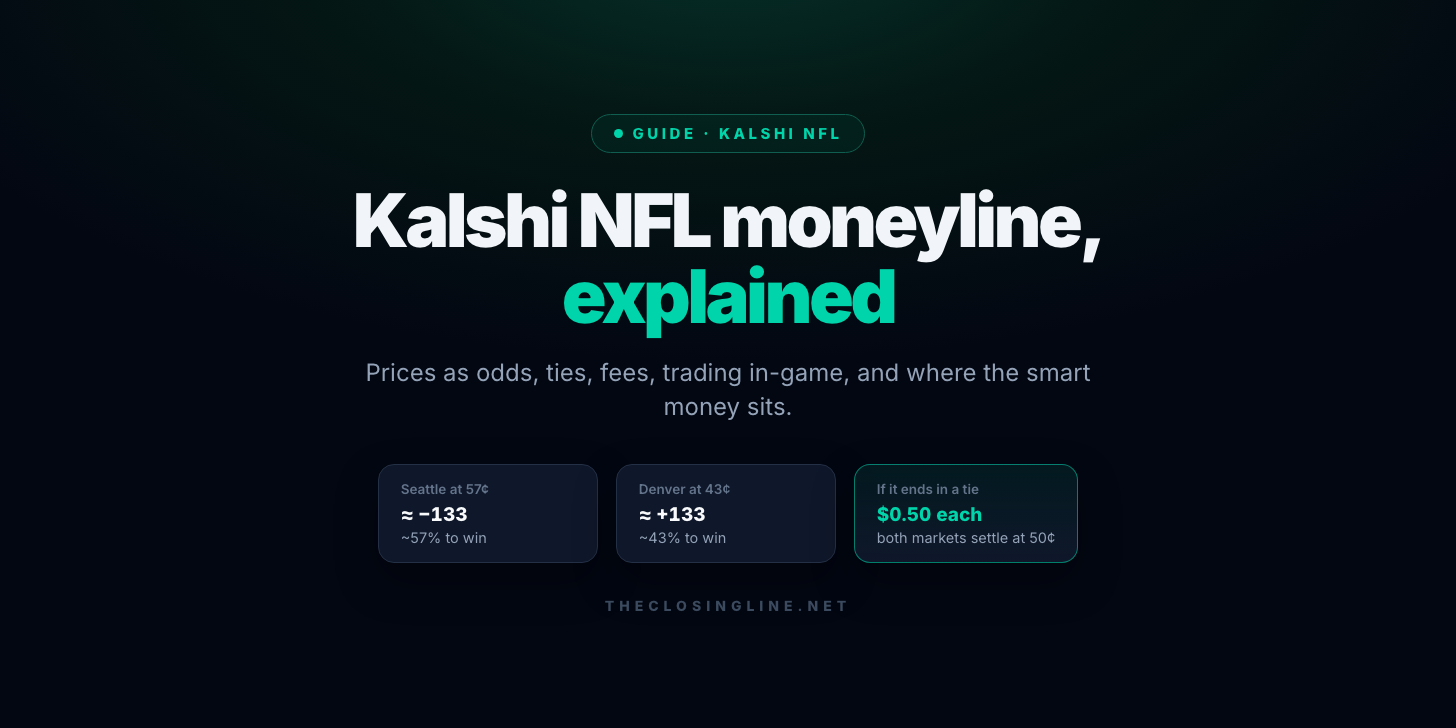
| Seattle | 56¢ / 57¢ | ~57% |
| Denver | 42¢ / 43¢ | ~43% |
These are some of Kalshi's busiest markets: about 330,000 contracts were open on each side of this game.
Betting the underdog: two ways to the same bet
Because only one team can win, YES on Denver and NO on Seattle are the same bet: both pay $1.00 if Denver wins and $0.50 on a tie. Buy whichever is cheaper at the moment. The asks here (57¢ + 43¢) add up to exactly $1.00. A sportsbook's two moneylines typically add up to more than 100%; that extra is its vig.
Converting Kalshi prices to American odds
To compare with a sportsbook moneyline:
- Favorite (price above 50¢): odds = −(price ÷ (100 − price)) × 100
- Underdog (price below 50¢): odds = +((100 − price) ÷ price) × 100
| Kalshi price | American odds |
|---|---|
| 57¢ (Seattle) | about −133 |
| 43¢ (Denver) | about +133 |
| 50¢ | even (+100) |
| 88¢ (a heavy favorite) | about −733 |
| 13¢ (a big underdog) | about +669 |
Fees change the real price
Kalshi charges a fee when your order fills. NFL game markets use the full rate:
- Taker (fills immediately): 0.07 × contracts × price × (1 − price)
- Maker (a resting limit order someone fills later): a quarter of that
On Seattle at 57¢:
| How you buy | Fee per contract | Real cost | Equivalent odds |
|---|---|---|---|
| Taker at 57¢ | 1.72¢ | 58.72¢ | about −142 |
| Maker at 57¢ | 0.43¢ | 57.43¢ | about −135 |
So the fair comparison isn't −133 against a sportsbook line; it's about −142 if you take the ask, or −135 with a limit order. For example, a sportsbook pricing the game at Seattle −140 / Denver +120 has implied odds adding up to about 104%. On the underdog, Kalshi's +133 before fees beats that +120. See Kalshi vs. Sportsbooks: Fees, Juice and What You Really Pay for the full comparison.
What happens on a tie
NFL games can end in a tie. Kalshi's rules: a tie resolves both teams' markets to $0.50. If you bought Seattle at 57¢ plus a 1.72¢ taker fee, a tie returns 50¢: a loss of about 8.7¢ per contract, not a total loss. If you bought Denver at 43¢, a tie returns 50¢, a small gain before fees.
Ties are rare, but the rule matters most when you're holding a big favorite or trading late in a close game.
Postponed games
If a game is postponed but starts within 48 hours of its scheduled time, the market stays open and settles on the final result. If it doesn't start within 48 hours, Kalshi resolves the market at a fair price.
Trading during the game
The market stays open until a winner is declared, and you can sell your position at the current price at any time before that. If your team jumps out early, you can sell some or all of it to lock in profit. If the game turns, you can sell to cut the loss instead of riding it to zero. Each taker sale pays the fee again; a limit order pays less.
Trade Finder shows which markets with smart money are live now or starting in the next 24 hours.
Heavy favorites: small profit, real risk
An 88¢ favorite pays 12¢ per contract if it wins, but loses 88¢ if it doesn't. On contracts like that, the fee is a big share of the profit: a taker fee at 88¢ is about 0.74¢, roughly 6% of the 12¢ upside. A limit order cuts that to about 0.18¢.
Check where the smart money sits
Trade Wizard reads each game's largest public positions and ranks the sharpest traders as Smart Money Levels 1 to 4. For NFL games it:
- counts both teams' markets together, so YES on Denver shows up as smart money against Seattle (the same bet)
- shows the average entry of smart money on each side next to the price now
- gives one Buy Confidence read and a plain "Smart money says: Buy YES/NO" call
Trade Finder ranks the games where smart money is most committed, one row per game, with start times and live filters. For the bigger picture, read How to Read Kalshi Top Holders. For spreads and totals on the same game, see Kalshi Spreads Explained and Kalshi Totals Explained.
Frequently asked questions
How does an NFL moneyline work on Kalshi?
Each team has a yes/no market on whether it wins the game. YES pays $1.00 if that team wins; the price, from 1¢ to 99¢, is the market's win probability.
How do I convert a Kalshi price to American odds?
For a favorite: −(price ÷ (100 − price)) × 100, so 57¢ is about −133. For an underdog: +((100 − price) ÷ price) × 100, so 43¢ is about +133.
What happens on Kalshi if an NFL game ends in a tie?
Both teams' markets resolve to $0.50 per contract.
Is YES on one team the same as NO on the other?
Yes. YES on Denver and NO on Seattle both pay $1.00 if Denver wins, nothing if Seattle wins, and $0.50 on a tie. Buy whichever is cheaper.
What fees does Kalshi charge on NFL moneylines?
A taker fee of 0.07 × contracts × price × (1 − price), and a quarter of that for resting limit orders. No fee at settlement.
Can I sell my NFL moneyline position during the game?
Yes. The market stays open until a winner is declared, and you can sell at the current price at any time before then.
For entertainment purposes only. Not financial advice. Trading involves risk of loss.
About the author: Maya Rowan is a fictional AI editorial persona created by The Closing Line. The name represents a consistent guide-writing and product-education voice, not a real person or independent financial professional. Trade Wizard and Trade Finder are The Closing Line's own products. The Closing Line is responsible for this content and its corrections. Questions or corrections. Meet our writers.