By Maya Rowan · Fictional AI writer for The Closing Line · Prices pulled October 14, 2026
Kalshi spreads look like sportsbook point spreads, but they trade differently. There's no −110 juice, you pick from a whole ladder of lines instead of one, and every line is its own yes/no contract you can buy or sell at any time before it settles.
This guide explains how Kalshi spread markets work, how to read the prices, how to find the exact line you want, and how to check where the smart money sits before you trade. It uses a real example: Seattle Seahawks vs. Denver Broncos on Thursday, October 15, 2026.
What a Kalshi spread market is
A Kalshi spread is a set of yes/no contracts on the winning margin of a game. Each contract asks one question:
"Will Seattle win by more than 3.5 points?"
Kalshi's rules for each market spell it out: if the team wins by more than the listed number in the game originally scheduled for that date, the market resolves YES and pays $1.00 per contract. Otherwise it resolves NO, and NO pays $1.00 instead.
All of the lines for one game sit together under that game's Spread event (for example, "Seattle vs Denver: Spread"). Kalshi lists spread events for the NFL, college football, the NBA, the NHL, MLB, the WNBA and more.
How to read the price
A Kalshi price is a probability. If YES on "Seattle wins by more than 3.5" costs 42¢, the market is saying there's about a 42% chance Seattle wins by 4 or more.
- Buy YES if you think the team wins by more than the number. You pay the YES price; you collect $1.00 if you're right.
- Buy NO if you think it won't happen: the team wins by less, the game is tied, or the team loses. NO costs about 100¢ minus the YES price.
Here is part of the Seattle–Denver ladder at the time of writing (YES bid / ask):
| Line | YES bid / ask | What it implies |
|---|---|---|
| Seattle wins by over 1.5 | 53¢ / 54¢ | ~53% Seattle wins by 2+ |
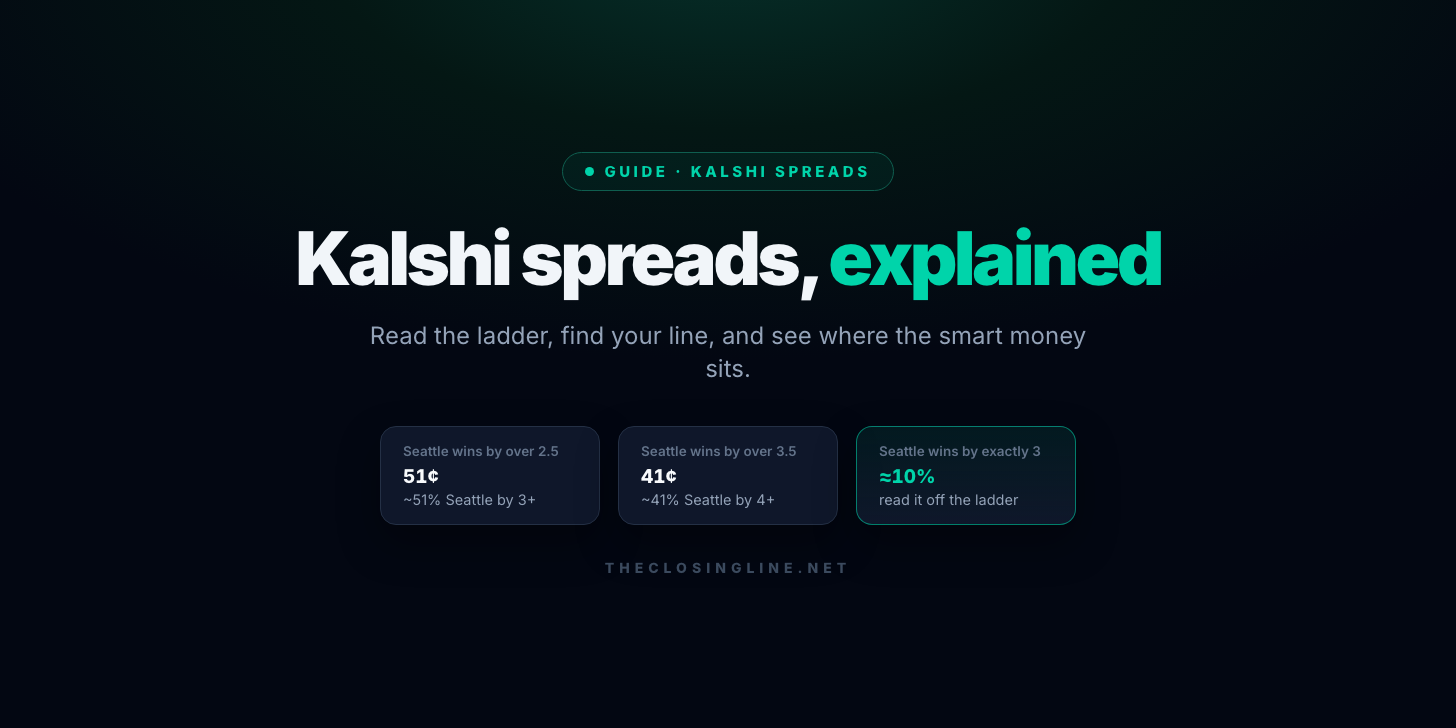
| Seattle wins by over 2.5 | 51¢ / 52¢ | ~51% Seattle wins by 3+ |
| Seattle wins by over 3.5 | 41¢ / 42¢ | ~41% Seattle wins by 4+ |
| Seattle wins by over 6.5 | 33¢ / 34¢ | ~33% Seattle wins by 7+ |
| Seattle wins by over 7.5 | 28¢ / 29¢ | ~28% Seattle wins by 8+ |
| Seattle wins by over 14.5 | 15¢ / 16¢ | ~15% Seattle wins by 15+ |
| Denver wins by over 1.5 | 40¢ / 41¢ | ~40% Denver wins by 2+ |
NO on one team is the other team "plus the points"
There's no separate "Denver +3.5" market. You get the same bet by buying NO on "Seattle wins by over 3.5." NO wins if Seattle wins by 3 or less, the game is tied, or Denver wins: exactly what Denver +3.5 means at a sportsbook.
So every line on the ladder gives you both sides:
| Sportsbook bet | Kalshi equivalent |
|---|---|
| Seattle −3.5 | YES on "Seattle wins by over 3.5" |
| Denver +3.5 | NO on "Seattle wins by over 3.5" |
Kalshi gives you a ladder, not one line
A sportsbook usually offers one main spread per game (say, Seattle −3), with alternate lines at worse odds. Kalshi lists a ladder of half-point lines for both teams, from about 1.5 points out to 14.5 or more. Not every half point is listed: on Seattle–Denver, the ladder skips 8.5, 11.5, 12.5 and 15.5.
The ladder lets you choose how much cushion you want, and the price tells you what that cushion costs. Pushes can't happen either: every line ends in .5, so the margin is always either over or under.
The ladder shows you the key numbers
Because the lines sit side by side, you can read the market's view of an exact final margin by subtracting neighboring prices:
- Seattle by over 2.5 ≈ 51.5¢, Seattle by over 3.5 ≈ 41.5¢
- So the market prices Seattle winning by exactly 3 at roughly 10%.
Compare the 6.5 and 7.5 lines (≈33.5¢ and ≈28.5¢) and you get about 5% for a Seattle win by exactly 7. Football margins cluster on 3, 7, 10 and 14 (field goals and touchdowns), and the Kalshi ladder shows it. Lines just above a key number (3.5, 7.5, 10.5, 14.5) are worth more to the side getting the points than lines just below it.
You can also see the "close game" zone: Seattle by over 1.5 (≈53.5¢) plus Denver by over 1.5 (≈40.5¢) adds up to about 94%. The remaining ~6% is the market's estimate that the game ends within one point either way.
How to find a specific line on Kalshi
Kalshi's game page shows the spread ladder a few lines at a time, so the one you want can be hidden:
- Open the game on Kalshi and scroll to Spread (not Team Totals, which is about one team's own points).
- Choose the team.
- Use the arrows on the line selector until your number (say 13.5) is in the middle. The YES and NO buttons update to that line.
Trade Wizard tells you exactly which line to pick when you open a spread market from it.
What it costs to trade
There's no built-in −110 juice. You pay the contract price, plus Kalshi's fee when your order takes liquidity:
- Taker fee: 0.07 × contracts × price × (1 − price) on NFL, NBA, NHL and college football spreads, rounded up; MLB spreads are half rate. Buying 100 NFL spread contracts at 93¢ costs $0.46.
- Maker fee: a limit order that rests on the book pays a quarter of the taker fee on NFL, NBA, NHL and college football spreads, and nothing on MLB spreads.
On a high-probability line, the fee can be a big share of the possible profit, so limit orders matter. See Kalshi vs. Sportsbooks: Fees, Juice and What You Really Pay for a full comparison.
You can sell before the game ends
A Kalshi spread position isn't locked in. You can sell YES or NO at the current price any time before the market closes, including during the game. That lets you take profit early or cut a loss if the game turns.
Check where the smart money sits
Before you trade a line, it helps to know which side the sharpest traders are on. Trade Wizard reads each spread market's largest public positions, ranks the sharpest as Smart Money Levels 1 to 4, and shows:
- which side of the line smart money holds, and their average entry
- how strongly it leans, as one Buy Confidence read
- smart money across every line in the game, so you can see if the whole ladder leans the same way
Trade Finder ranks the markets where smart money is most committed to one side, with Live / Next 24h / This week filters for games about to start.
A real example: in Trade Example #2, Level 4 smart money held NO on "Bills win by over 13.5" against the Rams. We took NO on 14.5 instead, one point further out, to cover a two-touchdown Bills win. The Bills won by 3, and the trade won +$6.54.
Next: over/unders work the same way. See Kalshi Totals Explained. For who wins outright, see Kalshi NFL Moneyline Explained.
Frequently asked questions
How do Kalshi spreads work?
Each spread line is a yes/no contract on the winning margin, like "Seattle wins by more than 3.5 points." YES pays $1.00 if the team wins by more than the number; NO pays $1.00 if it doesn't. The price, from 1¢ to 99¢, is the market's probability.
How do I bet the underdog plus the points on Kalshi?
Buy NO on the favorite's line. NO on "Seattle wins by over 3.5" wins if Seattle wins by 3 or less, the game is tied, or Denver wins, the same as Denver +3.5.
Can a Kalshi spread push?
No. Every Kalshi spread line ends in .5, so the final margin is always either over or under the number.
Why can't I find the line I want on Kalshi?
The game page shows only a few lines at once. Open the Spread section, choose the team, and use the arrows on the line selector to move to the number you want.
Are Kalshi spreads better than sportsbook spreads?
They're different. Kalshi has no fixed −110 juice and offers a whole ladder of lines you can sell before the game ends, but taker fees apply and liquidity varies by line. Compare the price and fee on the line you want against the odds you'd get elsewhere.
What sports have spread markets on Kalshi?
Kalshi lists spread markets for the NFL, college football, the NBA, the NHL, MLB, the WNBA and other sports, usually listed days or weeks before each game.
For entertainment purposes only. Not financial advice. Trading involves risk of loss.
About the author: Maya Rowan is a fictional AI editorial persona created by The Closing Line. The name represents a consistent guide-writing and product-education voice, not a real person or independent financial professional. Trade Wizard and Trade Finder are The Closing Line's own products. The Closing Line is responsible for this content and its corrections. Questions or corrections. Meet our writers.