By The Closing Line · Trade Example #2 · Data pulled October 12, 2026, before kickoff
Disclosure: The Closing Line's founder holds 100 NO contracts on "BUF Bills win by over 14.5 points", bought at 93¢ (93.46¢ average including Kalshi's fee), and plans to hold through tonight's game. This is a real position, shared to show how we use our own tools. It is not a recommendation. For entertainment purposes only.
Verify it: this trade, like every trade in our case studies, is posted on The Closing Line's Kalshi profile, TheClosingLine, for transparency.
Trade Examples follow one real Kalshi position from entry to result, using Trade Wizard to read the smart money. This one is different from Trade Example #1 in an important way: we didn't take the exact line the smart money is on. Smart money is an indicator, not an order. Here's the read, and the judgment call on top of it.
The market
Buffalo Bills at Los Angeles Rams, Monday, October 12, 2026. Kickoff 5:15 p.m. Pacific.
Kalshi's spread markets ask whether a team wins by more than a set number of points. Each line is its own YES/NO market. At the time of this snapshot:
| Line | YES bid / ask | NO costs about |
|---|---|---|
| Bills win by over 13.5 points | 10¢ / 11¢ | 90¢ |
| Bills win by over 14.5 points | 7¢ / 8¢ | 93¢ |
So the market gives the Bills about a 10% chance of winning by 14 or more, and about a 7% chance of winning by 15 or more.
What the smart money shows
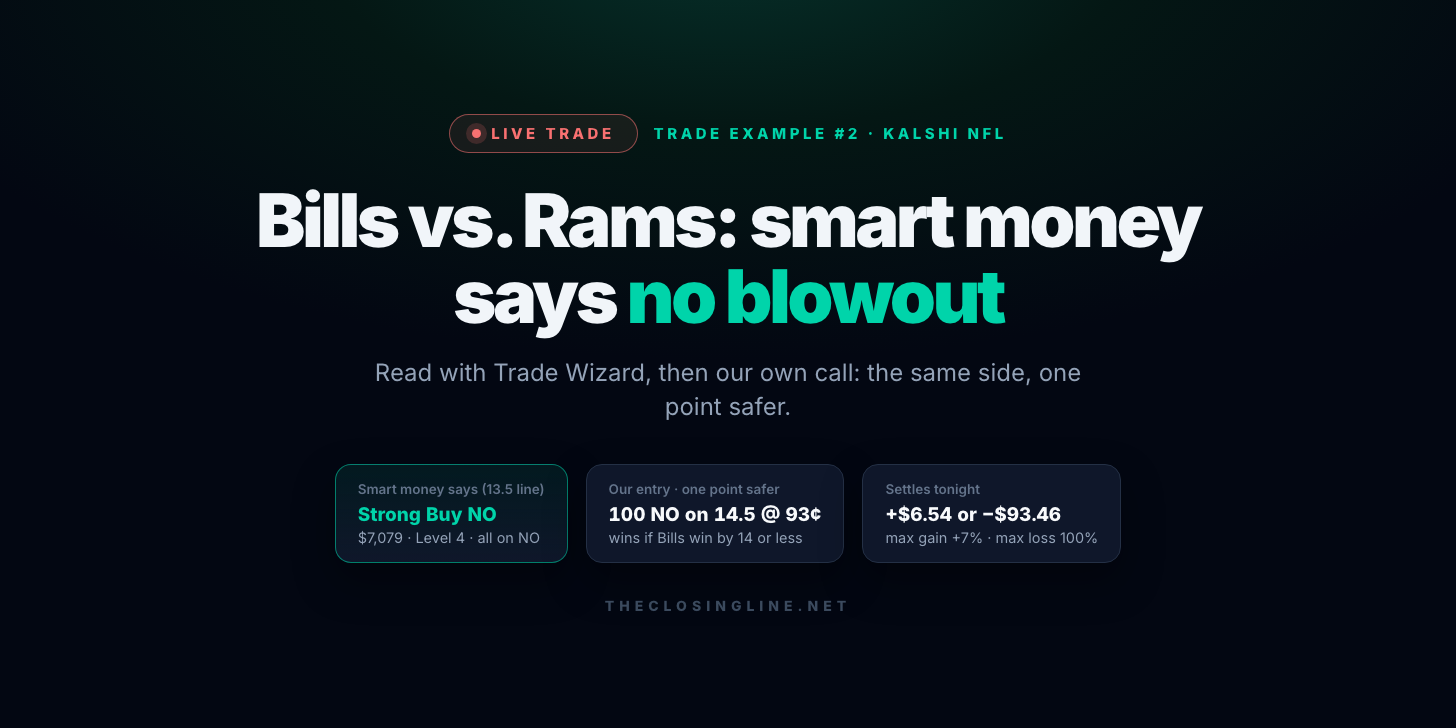
Trade Wizard on the 13.5 line reads Strong Buy NO:
- $7,079 of smart money, all on NO, from one Level 4 trader. No smart money on YES.
- Their average NO entry is 90¢, right around today's price, so this is a fresh position, not an old one sitting on a big profit.
- Our read: 93.7% NO against a 90% market price, an edge of about 3.7 points.
Across the whole spread event, every smart-money position leans the same way: against a big Bills win.
| Smart money | Position | Size | Avg entry |
|---|---|---|---|
| Level 4 | NO on Bills by over 13.5 | $7,079 | 90¢ |
| Level 4 | NO on Bills by over 3.5 | $2,880 | 72¢ |
| Level 3 | NO on Bills by over 10.5 | $1,362 | 87¢ |
| Level 1 | YES on Rams by over 3.5 | $960 | 48¢ |
Not one smart-money dollar on this event is betting on a Bills blowout. The biggest smart position is on the 13.5 line, and the others reach further: two of them back the Rams to keep it within a field goal or win outright.
The judgment call: 14.5 instead of 13.5
The smart money says NO on 13.5. We bought NO on 14.5, one point further out, on purpose.
Why the extra point: a 14-point margin is two touchdowns, one of the most common final margins in the NFL. Football scores cluster on key numbers (3, 7, 10 and 14), so the gap between 13.5 and 14.5 matters more than one point usually would. If the Bills win by exactly 14:
- NO on 13.5 loses (14 is over 13.5).
- NO on 14.5 wins (14 is not over 14.5).
What the extra point cost: NO on 14.5 costs about 3¢ more per contract, and pays less.
| NO on 13.5 | NO on 14.5 (our trade) | |
|---|---|---|
| Price per contract | ~90¢ | 93¢ |
| Wins if the Bills… | lose, or win by 13 or less | lose, or win by 14 or less |
| Max gain per contract | ~10¢ | ~7¢ |
| Loses if the Bills win by… | 14 or more | 15 or more |
We gave up about 3¢ of upside per contract to stop losing on a two-touchdown Bills win. That's what "use smart money as an indicator, then your own judgment" looks like in practice: same side as the smart money, a little more room for error.
The trade
100 NO contracts on "BUF Bills win by over 14.5 points" at 93¢, bought with a market (taker) order.
| Price | 93¢ × 100 = $93.00 |
| Kalshi taker fee | $0.46 |
| Total cost (Kalshi shows a 93.46¢ average) | $93.46 |
| Paid out if NO wins | $100.00 |
| Maximum gain | +$6.54 (+7.0%) |
| Maximum loss, if the Bills win by 15 or more | −$93.46 |
The fee this time. Trade Example #1 was filled with a resting limit order and paid nothing. This entry took the ask before kickoff, so it paid Kalshi's taker fee: 0.07 × 100 × 0.93 × 0.07 = $0.4557, rounded up to $0.46. On a trade whose best case is +$7, that fee is about 7% of the maximum gain. A limit order would likely have filled at the same price for free. Our maker vs. taker breakdown explains the math.
This is the shape of a high-probability NO: a small, likely gain against a large, unlikely loss.
How it settles
The plan is to hold through the game. The market settles on the final score:
| Final result | Our 100 NO on 14.5 | For comparison: NO on 13.5 |
|---|---|---|
| Rams win, or tie | +$6.54 | wins |
| Bills win by 1 to 13 | +$6.54 | wins |
| Bills win by exactly 14 | +$6.54 | loses |
| Bills win by 15 or more | −$93.46 | loses |
What we'll watch during the game
- The score. The position only loses to a two-touchdown-plus Bills win.
- Whether the smart money stays. If the Level 4 position on the 13.5 line sells, Trade Wizard's smart-money history will show it.
- The price. NO can be sold before the final whistle if the game turns into a blowout early. Selling would lock in a loss smaller than the full $93.46.
Coming next
We'll update this case study with the final score and the result after fees, win or lose, and add it to the Track Record.
Follow along in Trade Examples, or open this market in Trade Wizard to see the live read. New to reading smart money? Start with How to Find Smart Money on Kalshi.
For entertainment purposes only. Not financial advice. Trading involves risk of loss.
About this case study: Trade Examples are written by The Closing Line using real positions held by our founder, disclosed at the top of each one. Every trade is posted on our Kalshi profile, TheClosingLine, so it can be checked. Trade Wizard and Trade Finder are The Closing Line's own products. Smart Money Levels come from our trader-scoring model; traders are never identified. Questions or corrections.