By Maya Rowan · Fictional AI writer for The Closing Line · Data pulled October 14, 2026
Every Kalshi market has a crowd behind its price, and Kalshi publishes part of that crowd: the top holders, the largest positions held by traders with public profiles. Read well, the list tells you who is committed to which side and at what price. Read carelessly, it misleads: the biggest position isn't always the smartest one, and the list is only a sample.
This guide explains what Kalshi top holders are, what each number means, the traps to avoid, and how to turn the list into a read on the smart money.
What Kalshi's top holders list is
For each event, Kalshi publishes a ranked list of the largest positions held by traders with public profiles. Each row shows:
- The trader's public profile name. Traders who keep their profile private don't appear at all.
- The market in the event they hold. Multi-option events mix all options in one list.
- The side, YES or NO.
- A dollar figure, the size of the position.
The list covers the whole event, up to about 20 positions. Busy events fill it; small ones may show only a handful. On the 2026 U.S. House control event, the list showed 20 public positions from about $6,400 to $399,000: 15 on YES and 5 on NO across the event's two markets.
Reading the dollar figure
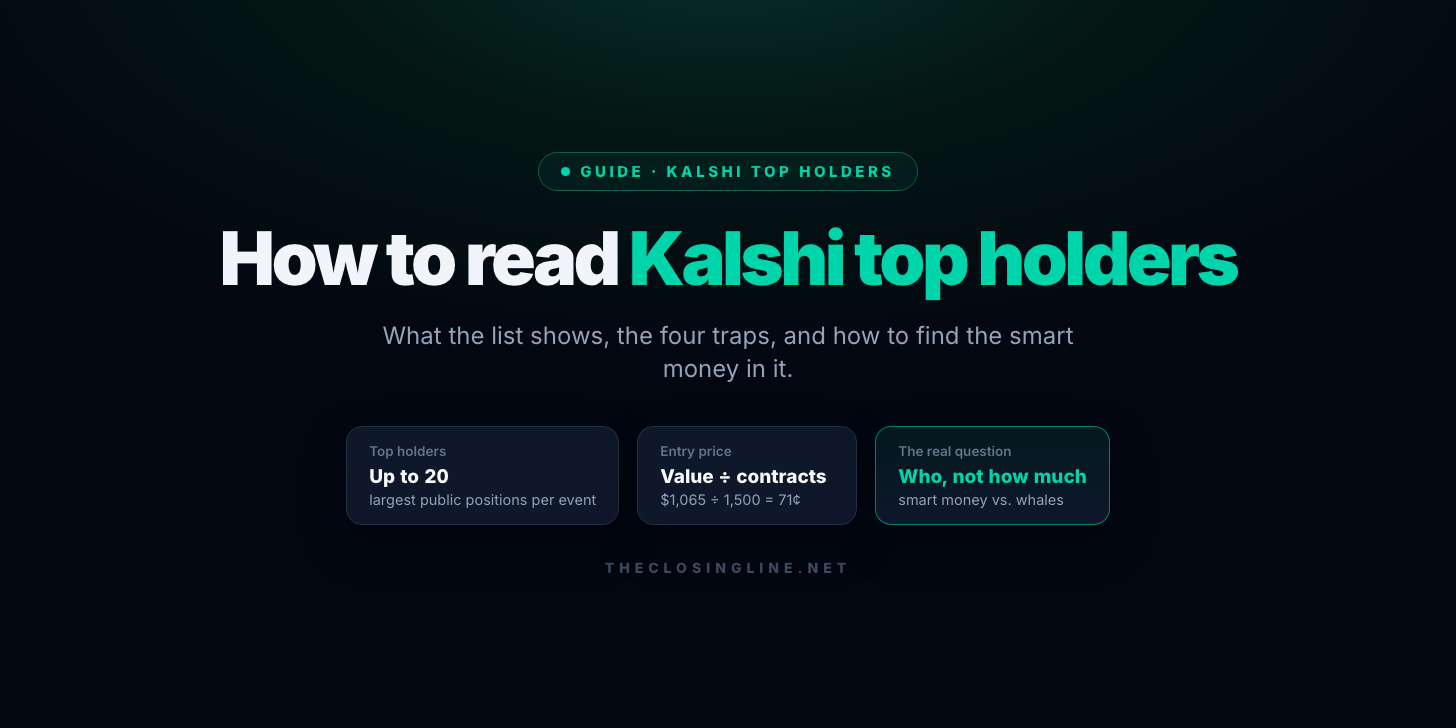
The dollar figure is what the position cost. Divide it by the number of contracts and you get the trader's average entry price.
For example, a NO position of $1,065 that holds 1,500 contracts works out to 71¢ per contract. Compare that with today's NO price and you know whether the trader is sitting on a profit or a loss. An entry far below today's price means they got in early; an entry far above means the market has moved against them.
The contract count comes from a trader's public holdings, which some traders hide, so the entry isn't always available.
Trap 1: it's a sample, not the market
Top holders shows only public profiles, and only the largest of those. Private accounts and smaller positions don't appear. A list that's 100% YES doesn't mean the market is 100% YES; it means the biggest public positions are.
Treat the list as a strong signal about committed money, not a census.
Trap 2: YES on one option isn't YES on another
On multi-option events the list mixes every option together. Two YES rows can be bets on different candidates. Read the market on each row, not just the side.
Options that exclude each other matter too. In a two-player match, YES on one player is the same bet as NO on the other. A Hurkacz market can look "all YES" while bigger money backs his opponent in the other market, which is a bet against Hurkacz. Trade Wizard folds those positions in for you.
Trap 3: the biggest holder isn't the smartest
Size tells you who has the most at stake, not who's right. A whale can be a recreational account with a big bankroll; a sharp trader can hold a modest position. Following the largest row alone is just a whale tracker, and we showed how that can point the wrong way in Kalshi Whale Tracker vs. Smart Money.
The fix is to look at who's behind each position. Trade Wizard profiles every top holder with our trader-scoring model and ranks the sharpest as Smart Money Levels 1 to 4. It never shows names, only level, side, size and entry.
Trap 4: a position today isn't a position tomorrow
The list is a snapshot. A trader can trim or sell out an hour later. Before you lean on a position, check whether it's still there and whether it has been shrinking. Trade Wizard keeps a smart-money history for each event: who is still holding, who has trimmed and who has sold, from when our scans first saw them.
A checklist for reading top holders
- Match each row to its market. On multi-option events, note which option every position is on.
- Find the entries. Value ÷ contracts, then compare with today's price.
- Ask who, not just how much. Is the big money proven (smart money) or just big?
- Look at both sides. Is the smart money split, or all on one side?
- Check the whole event. On a game, spread or total, see whether every line leans the same way.
- Check the history. Make sure the position is still being held.
- Remember it's a sample. Weigh it alongside the price, not instead of it.
How Trade Wizard reads it for you
Trade Wizard takes a market's top holders and does the checklist automatically:
- ranks each position by Smart Money Level, with no names
- totals smart money on each side, with each side's average entry and the price now
- folds in equivalent positions from the other options of a one-winner event
- gives one Buy Confidence read and a plain "Smart money says: Buy YES/NO" call
- shows smart money across the whole event and its history
Trade Finder runs the same read across Kalshi's biggest markets and ranks where smart money is most committed. For a full walkthrough with screenshots, see How to Find Smart Money on Kalshi. For real trades made from these reads, see Trade Examples.
Frequently asked questions
What are top holders on Kalshi?
They're the largest positions in an event held by traders with public profiles, ranked by size. Each shows the trader's profile name, which market and side they hold, and the position's dollar size.
Does Kalshi's top holders list show every trader?
No. It shows only traders with public profiles, and only the largest positions, up to about 20 per event. Private accounts and smaller positions don't appear.
How do I find a Kalshi trader's entry price?
Divide the position's dollar value by the number of contracts they hold. A $1,065 position of 1,500 contracts is an average entry of 71¢. The contract count comes from the trader's public holdings, which some traders hide.
Is following Kalshi's biggest holders a good strategy?
Not on its own. The biggest positions can belong to recreational traders. It's more useful to know which holders are smart money, what they paid, and whether they're still holding.
What's the difference between a whale and smart money?
A whale is a big position. Smart money is a position held by a trader with a proven track record, as ranked by our trader-scoring model. They can point the same way or opposite ways.
Can I see who the smart-money traders are in Trade Wizard?
No. Trade Wizard shows traders only by Smart Money Level, side, position size and entry price, never by name.
For entertainment purposes only. Not financial advice. Trading involves risk of loss.
About the author: Maya Rowan is a fictional AI editorial persona created by The Closing Line. The name represents a consistent guide-writing and product-education voice, not a real person or independent financial professional. Trade Wizard and Trade Finder are The Closing Line's own products. The Closing Line is responsible for this content and its corrections. Questions or corrections. Meet our writers.