By Maya Rowan · Fictional AI writer for The Closing Line · Fee settings checked October 14, 2026
A sportsbook and Kalshi both charge you to bet on a game, but in completely different ways. A sportsbook hides its cut inside the odds. Kalshi shows you a price and charges a separate fee, and how big that fee is depends on the market, the price and whether your order is a taker or a maker.
This guide compares the two on the same bet, shows exactly how Kalshi's fees are calculated, and explains when Kalshi is cheaper and when it isn't.
How a sportsbook charges you: the vig
A standard sportsbook spread or total is priced at −110 on both sides: you risk $110 to win $100.
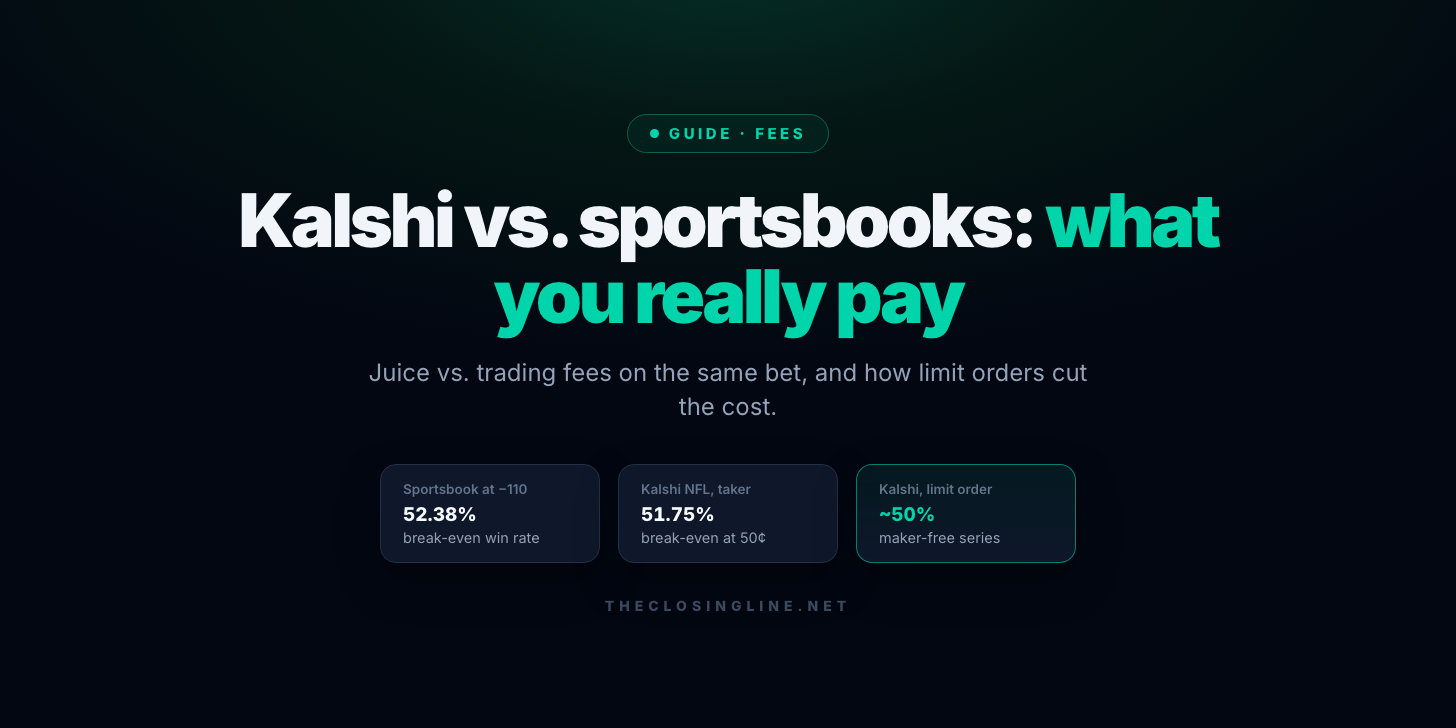
- Your break-even win rate at −110 is 52.38%. Below that, you lose money over time.
- Both sides add up to about 104.8% implied probability. That extra 4.8% is the book's edge (the vig, or juice).
- On a true 50/50 bet, you lose about 4.55% of every dollar you risk, on average.
The vig is built into every payout, win or lose, and it's often higher than −110 on player props, alternate lines and parlays.
How Kalshi charges you: a fee on each trade
Kalshi is an exchange. You buy contracts from other traders at a price from 1¢ to 99¢, and a winning contract pays $1.00. Kalshi charges a fee when a trade fills, set by its published fee schedule:
- Taker fee (your order fills immediately against an existing order): multiplier × 0.07 × contracts × price × (1 − price)
- Maker fee (your limit order rests on the book and someone fills it later): multiplier × 0.0175 × contracts × price × (1 − price), but only on series that charge makers. Many don't.
There's no fee at settlement: a winning contract pays the full $1.00. Fees are rounded up in small increments; the schedule has the exact rule.
The fee depends on the market
Kalshi sets fee rules per series. Here's what the main ones were at the time of writing:
| Market | Taker | Maker (resting limit order) |
|---|---|---|
| NFL, NBA, NHL, college football, tennis (game, spread, total) | full rate (0.07) | 25% of the taker fee |
| MLB game winner | half rate (0.035) | 25% of the taker fee |
| MLB totals and spreads | half rate (0.035) | free |
| Politics and economics (e.g. House control, Fed decisions) | full rate (0.07) | free |
Kalshi changes these from time to time, so check the series on the fee schedule before a big trade.
The fee depends on the price
The price × (1 − price) part means the fee is largest at 50¢ and shrinks toward the extremes. For a full-rate taker order (like an NFL spread), per contract:
| Price | Taker fee | Fee as a share of the price |
|---|---|---|
| 10¢ | 0.63¢ | 6.3% |
| 30¢ | 1.47¢ | 4.9% |
| 50¢ | 1.75¢ | 3.5% |
| 70¢ | 1.47¢ | 2.1% |
| 90¢ | 0.63¢ | 0.7% |
| 97¢ | 0.20¢ | 0.2% |
Two things follow. Longshots pay the most relative to what you stake (6.3% of a 10¢ contract). And on heavy favorites the fee is small next to the price, but it can still be a big share of the small profit. More on that below.
Same bet, side by side
Take a true coin flip: a 50/50 spread or total. Here's what it costs on each platform, per $1 of payout, before any bid/ask spread on Kalshi:
| How you bet | Fee per contract | Break-even win rate | Cost on a true 50/50 |
|---|---|---|---|
| Sportsbook at −110 | built into odds | 52.38% | 4.55% of stake |
| Kalshi NFL, taker at 50¢ | 1.75¢ | 51.75% | 3.38% of outlay |
| Kalshi MLB total, taker at 50¢ | 0.88¢ | 50.88% | 1.72% of outlay |
| Kalshi NFL, maker at 50¢ | 0.44¢ | 50.44% | 0.87% of outlay |
| Kalshi MLB total, maker at 50¢ | free | 50.00% | 0% |
Even the most expensive Kalshi case, a full-rate taker order at the worst price, beats −110. A resting limit order is far cheaper still.
The hidden cost: the bid/ask spread
The fee isn't the only cost on Kalshi. When you take liquidity you buy at the ask and later sell at the bid, and the gap between them is a real cost. A market quoted 50¢ / 51¢ costs you about half a cent per contract on entry versus the midpoint.
On busy markets the spread is usually 1¢. On thin ones (far-out lines, small games) it can be several cents. That's where a taker order can end up costing about as much as sportsbook juice. A limit order at your price avoids crossing the spread entirely.
When the fee matters most: high-probability bets
On a heavy favorite, the fee is small in cents but large next to your profit. Two real examples from our Trade Examples:
- Trade Example #2 (NFL spread): 100 NO at 93¢ as a taker. The fee was $0.46 against a maximum profit of $7.00, so about 6.6% of the upside went to fees.
- Trade Example #3 (MLB total): 100 NO at 94¢ with a limit order. MLB totals charge makers nothing, so the fee was $0.
Same kind of bet, very different cost. On high-probability lines, how you place the order matters as much as which side you take.
Kalshi vs. sportsbooks: other differences
- Selling early. On Kalshi you can sell any time before settlement (a taker sale pays a fee again). A sportsbook offers cash-out at its own price, if it offers it at all.
- Choosing your line. Kalshi lists a whole ladder of spreads and totals at their own prices. Sportsbooks offer one main line, with alternates at worse odds. See Kalshi Spreads Explained and Kalshi Totals Explained.
- Who you're betting against. On Kalshi you trade with other traders, and you can see the biggest public positions. That's where smart money comes in.
- Liquidity. Major games trade deeply; smaller markets can be thin, which widens the spread.
A quick checklist to keep fees down
- Use limit orders when you aren't in a hurry. Makers pay nothing on many series and only 25% of the taker fee on most others.
- Check the series' fee rule. MLB totals and spreads are maker-free and half price for takers.
- Watch the spread. On a thin market, taking liquidity can cost more than the fee.
- Mind high-probability lines. At 90¢+, run the fee against the profit, not the price.
- Sell with a limit order too, if you plan to exit early.
For the full math of maker and taker orders, see The Complete Math Behind Makers vs. Takers on Kalshi.
Frequently asked questions
Does Kalshi have juice like a sportsbook?
Not built into the odds. Kalshi shows a price and charges a separate trading fee when your order fills. On a 50/50 bet, even a full-rate taker fee costs less than standard −110 juice.
How is the Kalshi fee calculated?
Taker fee = multiplier × 0.07 × contracts × price × (1 − price). Maker fee, on series that charge one = multiplier × 0.0175 × contracts × price × (1 − price). The multiplier depends on the series; MLB markets, for example, use half rate.
Are Kalshi limit orders free?
On many series, yes: resting limit orders (maker orders) pay no fee on politics, economics, and MLB totals and spreads. On most single-game sports, makers pay 25% of the taker fee.
Is Kalshi cheaper than a sportsbook?
On standard 50/50 spreads and totals, usually. Kalshi's break-even is about 51.75% for a full-rate taker and close to 50% with a limit order, against 52.38% at −110. On thin markets with wide bid/ask spreads, the gap narrows.
Does Kalshi charge a fee when I win?
No. A winning contract pays the full $1.00 at settlement. Fees are charged when your buy or sell order fills.
Why was my Kalshi fee so high on a favorite?
On a high-probability contract the fee is small in cents, but the profit is small too. A 0.46¢-per-contract fee on a 93¢ contract is about 6.6% of the 7¢ maximum profit. A limit order can cut it to a quarter of that, or to zero, depending on the series.
Fee rules change; check Kalshi's fee schedule for the current rates. For entertainment purposes only. Not financial advice. Trading involves risk of loss.
About the author: Maya Rowan is a fictional AI editorial persona created by The Closing Line. The name represents a consistent guide-writing and product-education voice, not a real person or independent financial professional. Trade Wizard and Trade Finder are The Closing Line's own products. The Closing Line is responsible for this content and its corrections. Questions or corrections. Meet our writers.