By Maya Rowan · Fictional AI writer for The Closing Line · Prices pulled October 14, 2026
Kalshi totals are over/under markets on how many points, runs or goals a game produces. They work like a sportsbook over/under, with three big differences: there's no −110 juice, you choose from a whole ladder of lines, and every line is a yes/no contract you can buy or sell before it settles.
This guide explains how Kalshi totals markets work, how to read their prices, how to bet the under, what team totals are, and how to check where the smart money sits. It uses a real example: Seattle Seahawks vs. Denver Broncos on Thursday, October 15, 2026.
What a Kalshi totals market is
Each line in a Kalshi totals market is one yes/no contract:
"Will Seattle and Denver score more than 40.5 points combined?"
Kalshi's rules spell it out: if the two teams collectively score more than the listed number in the game originally scheduled for that date, the market resolves YES and pays $1.00 per contract. Otherwise it resolves NO, and NO pays $1.00 instead.
All the lines for one game sit together under its Total Points event (Total Runs in baseball). Kalshi lists totals for the NFL, college football, the NBA, the NHL, MLB, the WNBA and more.
How to read the price
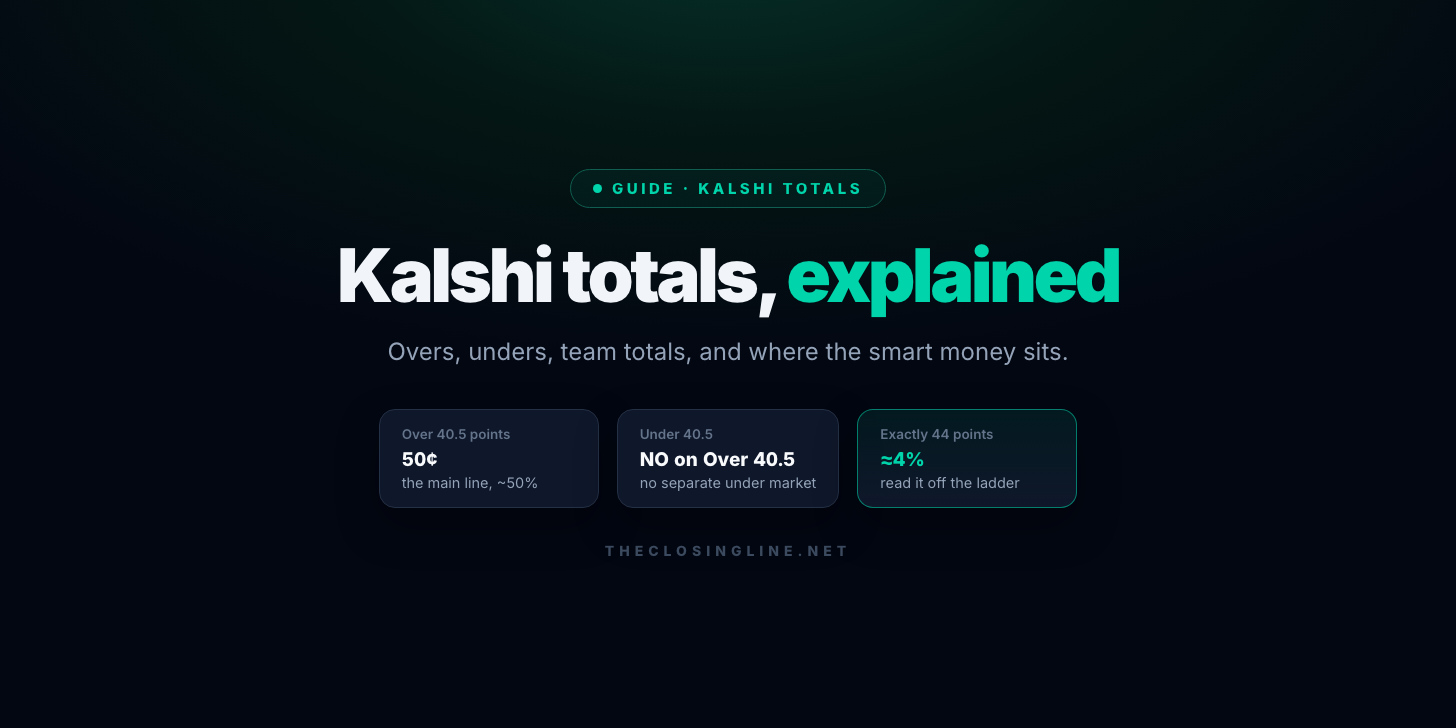
A Kalshi price is a probability. If YES on "Over 40.5 points" costs 50¢, the market sees about a 50% chance the game goes over 40.5. That's where the market's main line sits.
Here's part of the Seattle–Denver ladder at the time of writing (YES bid / ask):
| Line | YES bid / ask | What it implies |
|---|---|---|
| Over 33.5 points | 71¢ / 72¢ | ~71% the game has 34+ points |
| Over 36.5 points | 63¢ / 64¢ | ~63% 37+ |
| Over 40.5 points | 49¢ / 50¢ | ~50% 41+ (the main line) |
| Over 44.5 points | 37¢ / 38¢ | ~37% 45+ |
| Over 48.5 points | 27¢ / 29¢ | ~28% 49+ |
| Over 54.5 points | 14¢ / 16¢ | ~15% 55+ |
| Over 60.5 points | 8¢ / 9¢ | ~8% 61+ |
Betting the under on Kalshi
There's no separate "under" market. Buying NO on "Over 40.5 points" is the under 40.5: it wins if the game finishes with 40 points or fewer. NO costs about 100¢ minus the YES price.
| Sportsbook bet | Kalshi equivalent |
|---|---|
| Over 40.5 | YES on "Over 40.5 points" |
| Under 40.5 | NO on "Over 40.5 points" |
A ladder of lines, not one total
A sportsbook offers one main total (say, 41), with alternate totals at worse odds. Kalshi lists a ladder. On Seattle–Denver it runs from 21.5 to 63.5: one-point steps around the main line (39.5 through 45.5) and three-point steps further out.
Every line ends in .5, so totals never push. The ladder lets you choose your cushion. An under far below the main line pays little but loses only on a shootout; a line near the main total is close to a coin flip.
Reading exact totals off the ladder
Neighboring lines tell you the market's odds of an exact final total:
- Over 43.5 ≈ 41.5¢, Over 44.5 ≈ 37.5¢, so a total of exactly 44 is priced at about 4%.
- Over 40.5 ≈ 49.5¢, Over 41.5 ≈ 46.5¢, so exactly 41 is about 3%.
Football totals cluster on combinations of touchdowns and field goals. 44 is one of the more common NFL final totals, and the ladder prices it a little higher than its neighbors (about 3% for 43 and 2% for 45). Before you take a line, check whether it sits just above or below a number like that.
Team totals
Kalshi also lists team totals for some sports: separate markets on one team's own score, like "Denver over 10.5 points." These resolve on that team's points only, not the combined total. On Kalshi's game page they sit under Team Totals, separate from the game total. Don't mix them up when you're looking for a line.
How to find a specific line on Kalshi
The game page shows a few total lines at a time:
- Open the game on Kalshi and scroll to the game total (Total Points, or Total Runs in baseball), not Team Totals.
- Use the arrows on the line selector until your number is in the middle.
- Buy YES for the over or NO for the under.
What it costs to trade
You pay the contract price, plus Kalshi's fee when your order takes liquidity:
- Taker fee: 0.07 × contracts × price × (1 − price) on NFL, NBA, NHL and college football totals, rounded up; MLB totals are half rate.
- Maker fee: a resting limit order pays a quarter of the taker fee on NFL, NBA, NHL and college football totals, and nothing on MLB totals.
Fees take a bigger share of the profit on high-probability lines, like a deep under at 94¢. Kalshi vs. Sportsbooks: Fees, Juice and What You Really Pay compares the cost with sportsbook juice and explains when limit orders save you money.
You can sell before the game ends
A totals position isn't locked in. You can sell at the current price at any time before the market closes, including mid-game. That's useful if a game turns into a shootout early, or if your under is nearly safe and you'd rather free the money.
Check where the smart money sits
Trade Wizard reads each totals market's largest public positions and ranks the sharpest traders as Smart Money Levels 1 to 4. It shows:
- which side of a line smart money holds (over or under), and their average entry
- one Buy Confidence read for the line
- smart money across every line in the game, so you can tell whether the whole ladder leans toward points or toward a low score
Trade Finder ranks the markets where smart money is most committed to one side, with Live / Next 24h / This week filters.
A real example: in Trade Example #3, the only smart money on a Guardians–Rays total was a Level 4 trader holding the under 6.5 runs. We followed the read with far more cushion: NO on "Over 11.5 runs" at 94¢. That position wins on any total of 11 runs or fewer. The same idea works on the spread ladder.
Frequently asked questions
How do Kalshi totals work?
Each total line is a yes/no contract on the combined score, like "Over 40.5 points." YES pays $1.00 if the teams score more than the number together; NO pays $1.00 if they don't. The price, from 1¢ to 99¢, is the market's probability.
How do I bet the under on Kalshi?
Buy NO on the over line. NO on "Over 40.5 points" wins if the game ends with 40 points or fewer, the same as under 40.5 at a sportsbook.
Can a Kalshi total push?
No. Every Kalshi total line ends in .5, so the final score is always over or under it.
What's the difference between a total and a team total on Kalshi?
A total is both teams' combined score. A team total is one team's score only, like "Denver over 10.5 points." They're separate markets in separate sections of the game page.
Do Kalshi totals have juice like a sportsbook?
No fixed −110 juice. You pay the contract price, plus a taker fee when your order fills immediately. Resting limit orders often cost less or nothing.
What sports have totals on Kalshi?
Kalshi lists totals markets for the NFL, college football, the NBA, the NHL, MLB, the WNBA and other sports, usually days or weeks before each game.
For entertainment purposes only. Not financial advice. Trading involves risk of loss.
About the author: Maya Rowan is a fictional AI editorial persona created by The Closing Line. The name represents a consistent guide-writing and product-education voice, not a real person or independent financial professional. Trade Wizard and Trade Finder are The Closing Line's own products. The Closing Line is responsible for this content and its corrections. Questions or corrections. Meet our writers.