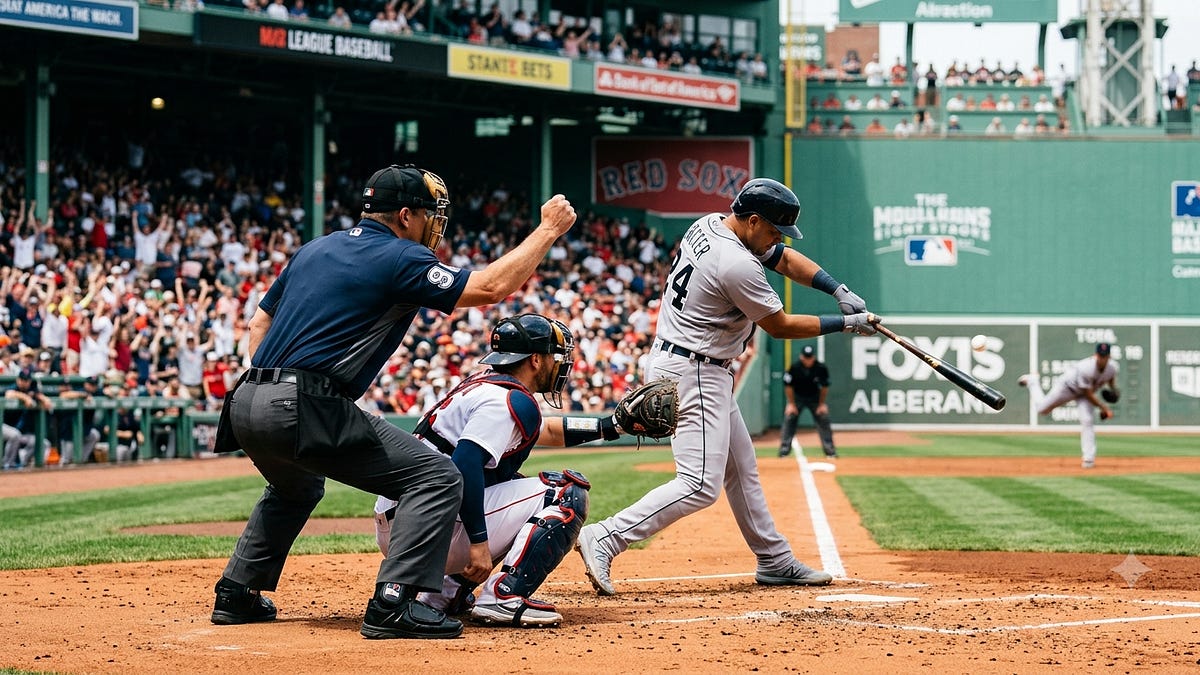
Every baseball bet you make has a variable in it that you almost certainly didn’t check: the name of the guy standing behind the catcher.
Home plate umpires are not interchangeable. They call meaningfully different strike zones, and those differences cascade through everything a bettor cares about — strikeout rates, walk rates, run scoring, game totals, first-inning scoring. The effect is real, it’s measurable, and there’s a public database for it.
Here’s the part most articles on this topic won’t tell you: the edge is dying. It’s smaller than it was two years ago, it’s shrinking every season, and robot umpires are arriving. So let’s do this properly — the mechanism, the magnitude, and an honest assessment of how much juice is actually left.
The mechanism: a wider zone changes everything downstream
The rulebook defines a strike zone. Human beings enforce it, and they enforce it differently. Some umpires call a zone an inch or two wider than average. Some squeeze it.
That single difference cascades:
A wide zone (a “pitcher’s ump”): More borderline pitches get called strikes. Pitchers work ahead in counts. Hitters, protecting against the expanded zone, start swinging at pitches they’d otherwise take. Strikeouts go up. Walks go down. Fewer baserunners means fewer runs, and games move faster.
A tight zone (a “hitter’s ump”): Borderline pitches get called balls. Pitchers fall behind, and a pitcher behind in the count has to come into the zone with something hittable. Walks rise. At-bats lengthen. More traffic on the bases means more scoring chances.
The chain is: zone size → count leverage → strikeout and walk rates → baserunners → runs. Every link is measurable, which is why this is one of the few “situational” betting angles with real data behind it rather than vibes.
The magnitude: how much is it actually worth?
Here’s where the numbers matter, and where you should be skeptical of anyone quoting a huge figure.
The most commonly cited estimate is that a strong pitcher’s-umpire assignment produces roughly 0.3 to 0.5 fewer runs than the posted total would otherwise suggest, with some analysts pegging the extreme spread between the most pitcher-friendly and most hitter-friendly umps at around half a run per game. That is a real, tradeable number on a total — half a run is a meaningful chunk of a 8.5 line.
It also shows up in props:
-
Strikeout props. An umpire who calls even 2% more strikes than average gives a pitcher roughly two extra strikes over the ~100 called pitches in a typical start. Two strikes can be the difference between 5 Ks and 7 Ks — exactly the margin a strikeout prop hinges on.
-
NRFI (No Run First Inning). League average is roughly a 55% chance neither team scores in the first. Umpires with zone-suppressing tendencies push that rate up; hitter-friendly umps push it down.
-
Walk-dependent pitchers. A control pitcher who lives on the corners is more exposed to a tight zone than a power pitcher who works in the middle. The umpire matters more for some starters than others — which is where the sharper reads live.
The stacking principle: The strongest spots are the ones where the umpire agrees with everything else. A wide-zone umpire, two strikeout pitchers, a pitcher-friendly park, cold weather → that’s an under with four factors pointing the same direction. A tight-zone umpire, two control pitchers who need the corners, a bandbox park, wind blowing out → that’s an over with real support. The umpire is rarely the whole bet. It’s the tiebreaker that turns a lean into a play.
Now the honest part: this edge is shrinking fast
Most umpire-betting content stops at “here’s the edge, go get it.” That’s not the whole truth, and you deserve the whole truth.
MLB changed how it grades umpires, and zones tightened league-wide. For roughly two decades, umpires were graded with a 2-inch buffer on every side of the plate — call a pitch two inches off and it still counted as correct. As part of the new labor agreement with the umpires’ union, that buffer shrank to three-quarters of an inch. Umpires responded exactly as you’d expect: fewer called strikes on the edges, tighter zones, more consistency across the board.
Accuracy is at an all-time high. Statcast data shows ball/strike call accuracy has improved every single year since pitch tracking began. It’s now north of 88% correct — the highest since Statcast launched, up from under 84% in 2016. Umpires are simply getting better, and better umpires are more similar to each other. The whole edge depends on umpires being different. As they converge, the differences that make the bet worth placing compress.
Here’s the finding that should really give you pause. When the zone tightened, offense... didn’t move. League-wide hitting went from .243/.312/.399 and 4.39 runs per game to .242/.316/.392 and 4.34 runs per game. Essentially identical. The actual difference in ball/strike call rate worked out to less than one pitch per game. Players felt the zone was tighter. The scoreboard barely noticed. That’s a powerful reminder that the story (”the zone changed!”) and the tradeable effect (”runs changed!”) are not the same thing, and that the umpire effect on any single game is far smaller than the confident content around it implies.
Even the umpire-betting industry has cut its own sizing. One handicapper who sells this exact angle publicly admits that where they used to play 2 units on a strong umpire mismatch, they’re now at 1.5 units, explicitly because “individual umpire tendencies are more compressed than in previous years.” When the people selling the edge are quietly shrinking their own bets on it, believe them.
And then there’s the robot. MLB is rolling out the ABS (Automated Ball-Strike) challenge system in 2026. It doesn’t replace the umpire outright — teams get challenges — but it systematically corrects the worst misses, which are precisely the calls that create umpire-to-umpire variance. FanGraphs literally titled its last analysis of the old era “Your Final Pre-Robo-Zone Umpire Accuracy Update.” The entire premise of umpire handicapping is that different humans call different zones. ABS exists to make that untrue.
So is it still worth doing?
Yes — with clear eyes about what you’re getting.
It’s still a real, measurable variable, and most people still don’t check it. That’s the definition of an edge: information that’s public but ignored. The data is free (umpire scorecards and tendency databases are all over the internet), the assignment is posted before the game, and the majority of bettors never look. Half a run of expected value on a total, in the extreme spots, is not nothing.
But treat it as a tiebreaker, not a thesis. Never bet a total because of the umpire. Bet a total because the pitchers, park, and weather support it — and let the umpire assignment tell you whether to pull the trigger or pass. The umpire is the last factor you check, not the first.
Size it down. The edge is smaller than it was in 2023, smaller than it was last year, and will likely be smaller next year. Whatever you would have bet on an umpire angle two seasons ago, bet less now.
Verify the sample. Umpire tendency profiles need real sample size — most trackers won’t publish a profile under 10 games, and tendencies from three seasons ago may not reflect a guy calling a post-buffer-change zone today. Old umpire data is actively misleading in the current era.
And know the clock is running. This is one of the rare betting angles with a visible expiration date on it. When ABS matures, this piece becomes a history lesson.
The takeaway
The home plate umpire is worth something like half a run in the extreme cases — enough to move a total, tip a strikeout prop, and swing an NRFI. It’s a genuinely under-checked variable, it’s free to look up, and it’s one of the few situational angles with hard data instead of narrative behind it.
It’s also an edge in visible decline: tighter grading, rising accuracy, converging zones, and a robot in the on-deck circle. The honest position isn’t “here’s a secret money printer.” It’s “here’s a real, shrinking edge — use it as a tiebreaker, size it small, and enjoy it while it lasts.”
The guy behind the plate still matters. Just less every year — and one day soon, not at all.
Sourcing: The ~0.3-0.5 run effect on totals and the ~0.5-run spread between extreme umpires are estimates from public umpire-betting analyses. The umpire grading buffer change (2 inches → 0.75 inches, per the December 2024 labor agreement) and the resulting tighter zones were reported by The Athletic and CBS Sports. League offensive lines (.243/.312/.399, 4.39 R/G vs. .242/.316/.392, 4.34 R/G) and the “less than one pitch per game” call-rate difference are per CBS Sports. Ball/strike accuracy above 88% (up from under 84% in 2016) is per Statcast. ABS challenge-system rollout for 2026 per MLB and FanGraphs. The “2 units → 1.5 units” sizing reduction is a public statement from an umpire-focused handicapping site. Umpire tendencies require adequate sample size (typically 10+ games) and pre-2025 data may not reflect current zone-calling. Nothing here is betting advice.