Yesterday I published the scanner — the free tool that flags where Kalshi disagrees with the sportsbooks — and walked through a live example: the Tigers–Astros game, where Kalshi and the betting markets disagreed by a full 10 cents. You can read that launch piece here.
The natural next question, and the only one that matters, is simple: did it actually work?
So let’s check. Not with a hypothetical. With that same real game, the real disagreement the scanner flagged before first pitch, and the real result.
The setup
Tuesday night, June 16. Detroit Tigers at Houston Astros, 8:10 PM ET. Here’s what the scanner showed before the game:
-
Kalshi: Houston to win at 50¢ — the prediction market called it a coin flip.
-
Book fair line: 60¢ — the vig-stripped sportsbook consensus had Houston as a clear favorite, off BetOnline.ag’s −161.
-
The gap: +10¢, one of the largest disagreements on the board that night.
I cross-checked it against FanDuel at the time, which had Houston at 61% to win — almost exactly the book fair number. So the picture was clean and stark: the entire sportsbook industry thought Houston was about a 60% favorite. Kalshi was pricing them as a 50/50 toss-up.
When two markets disagree that hard on the same game, one of them is wrong. The scanner’s whole premise is that the sportsbooks — with their decades of infrastructure and billions in handle — are usually the sharper number, and that a Kalshi price drifting from the book consensus is more likely to be the mispriced side. So the scanner was implicitly pointing one direction: Houston at 50¢ on Kalshi looked like a buy.
Then they played the game.
What happened
For most of the night, it looked like Kalshi’s coin-flip price might be the right one.
Houston’s Framber Valdez and Detroit’s pitching traded zeros early. Detroit scratched out a run in the 2nd. Houston answered with one in the 5th. Through seven innings it was 1-1 — exactly the nail-biter a 50/50 market would predict, and the kind of game where the “Kalshi was right, it really was a coin flip” story writes itself.
Then the 8th inning happened.
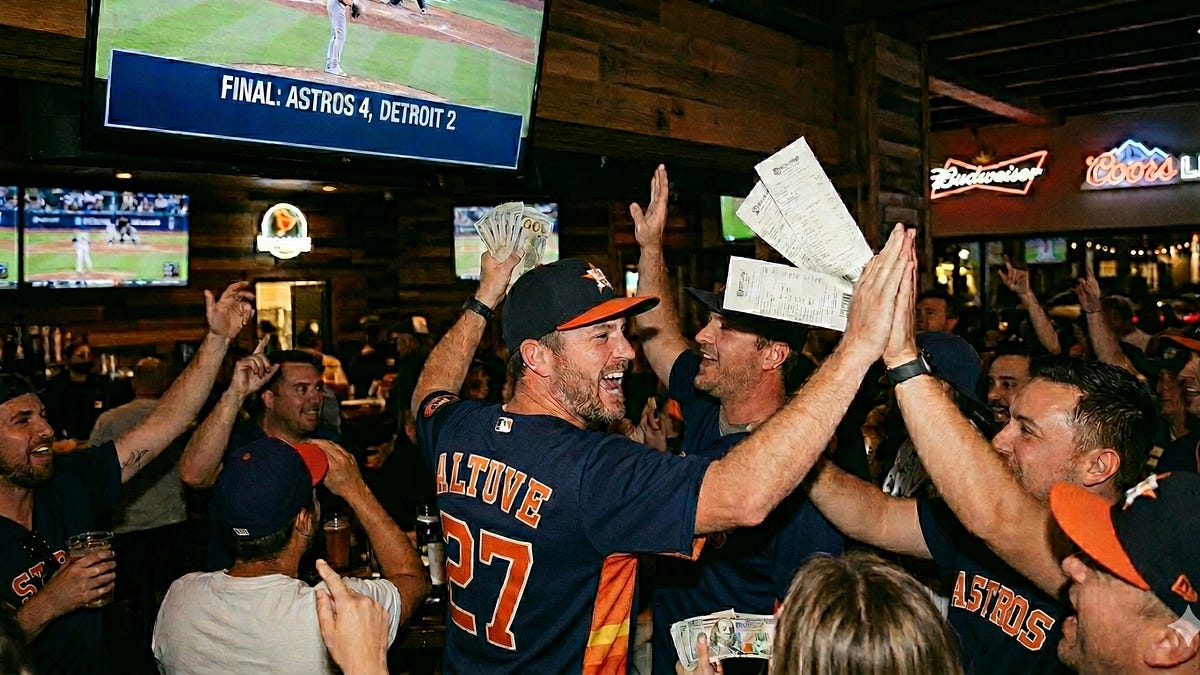
Houston put up a three-spot in the bottom of the 8th — Raynel Delgado drove in two, Jeremy Peña added another RBI — to break the game open 4-1. Detroit got one back in the 9th but Josh Hader slammed the door. Final: Houston 4, Detroit 2.
The favorite won. The way the box score reads — Houston out-hit Detroit 9 to 5, drew more walks, and got the big innings when it mattered — this wasn’t a fluke. The Astros were the better team on the night, which is precisely what a 60% line was telling you and a 50% line wasn’t.
What the trade actually returned
Here’s the part that matters for anyone who acted on the gap.
If you’d followed the scanner toward the sportsbook number and bought Houston YES at 50¢ on Kalshi, that contract resolved at $1.00 when Houston won. That’s a clean double — 100% return — on a single game, on a market the prediction exchange had priced as a coin flip.
Put concretely: $500 into Houston YES at 50¢ buys you 1,000 contracts. Houston wins, each contract pays a dollar, you collect $1,000. A $500 profit, minus Kalshi’s fee, on one night.
That’s not because anyone had a magic read on the Astros. It’s because the scanner found a market where Kalshi’s price had drifted away from the sharp consensus, and the sharp consensus was right. You didn’t need to know anything about Framber Valdez’s splits. You needed to know that 50¢ and 60¢ can’t both be correct, and that the books are usually the ones who’ve done the homework.
One game proves nothing — and that’s the point
I want to be honest about what this is and isn’t.
This is one game. A single result doesn’t prove the scanner is a money printer, and I’m not going to pretend it does. The books are favored to be right on average, over a large sample — but “on average” means plenty of individual games where Kalshi turns out to be the sharper price and the favorite loses. If Detroit had pushed across two in the 9th instead of one, this article would have a different headline, and I’d be writing that one too. The honesty is the product.
What one game can show is that the tool does what it claims: it surfaced a real, sizable disagreement before first pitch, and the disagreement was tradeable. The +10¢ gap wasn’t noise — it was a genuine difference of opinion between two markets, and it resolved in favor of the side the scanner pointed at. That’s the mechanic working exactly as designed.
The edge isn’t in any single flagged game. It’s in doing this over and over — taking the side the sharp consensus favors when Kalshi drifts far enough off it to clear the fees, and letting the math play out across dozens of games. Some you lose. The point is whether you’re consistently getting a better price than the number deserves. Tuesday night, you were.
How to play along
This is the first Scanner Report — I’m going to keep doing these. When the scanner flags a big gap, I’ll note it, and after the game resolves I’ll come back and show you what happened, win or lose. No cherry-picking. If the scanner has a bad week, you’ll read about the bad week here.
Want to run your own? The scanner is live and free at theclosingline.net. It’s still in beta, so the data’s getting sharper by the day, and email and text alerts are coming soon — set a threshold, pick your sports, and get pinged the moment a gap like Houston-Detroit shows up, instead of finding it after the fact. Create a free account and you’ll be first in line when alerts go live.
Before you place anything tonight, run it through the scanner and the fee calculator. Houston at 50¢ was sitting right there for anyone who looked.
When the prediction market and the betting market disagree, somebody’s wrong. Tuesday night, it was Kalshi — and the scanner called it.
Game: Tigers @ Astros, June 16, 2026, final Houston 4–2. Pre-game scanner reading: Kalshi Houston 50¢ vs. book fair 60¢ (BetOnline.ag −161), cross-checked against FanDuel 61%. Prices were live at the time and move continuously. A flagged gap reflects market disagreement, not a guarantee — the sharp side wins on average, not every time. Returns cited are before Kalshi fees. This is one result in what will be an ongoing, no-cherry-picking series; past results don’t guarantee future ones. Nothing here is financial advice.