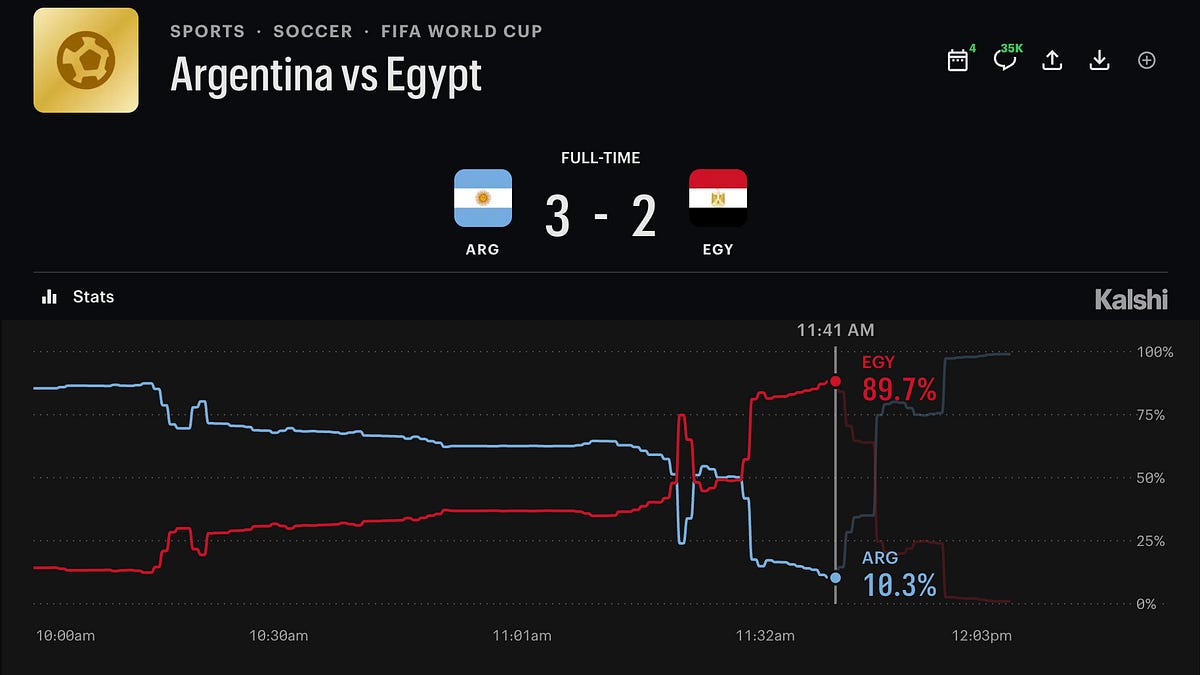
Yesterday, on a Kalshi chart, you could watch a soccer team die and come back to life in real time.
Argentina versus Egypt, World Cup Round of 16, Atlanta. Argentina — the defending champions, Messi and all — opened as heavy favorites, trading around 85% to win the match. Normal. Expected. Then the game happened, and the win-probability line went somewhere almost no line ever goes.
Egypt scored. Then Egypt scored again. By the second half, the Kalshi market had Egypt at 89.7% to win and Argentina crashed to 10.3%. The defending champions, on the brink of one of the biggest upsets in World Cup history, priced as roadkill.
Then Argentina scored three goals in the last eleven minutes and won 3-2.
Anyone who bought Argentina at 10¢ in that window got a contract that paid out at a dollar. A clean 10x, on a team the market had all but buried. The chart of that match is a masterclass in something most bettors never really internalize, so let’s break it down.
What actually happened on the field
The match report, for context, because the sequence matters:
Egypt took a shock lead in the 15th minute (Yasser Ibrahim, header). Messi missed a first-half penalty — saved. Egypt doubled the lead in the 67th minute (Mostafa Zico). At that point Argentina were down 2-0 with about 20 minutes left, and they had never — not once in 13 previous World Cup matches — come back from two goals down to win.
Then: Romero pulled one back in the 79th. Messi equalized in the 83rd. Enzo Fernández headed in the winner in the 92nd minute, stoppage time. 3-2 Argentina.
Here’s the number that makes the whole story. According to Opta’s win-probability model, at the moment Romero scored to make it 2-1, Argentina had a 0.6% chance of winning. Not 10% — 0.6%. The independent model and the Kalshi market agreed on the shape of reality: Argentina was done. And then Argentina won anyway.
The lesson most people take — and why it’s wrong
The tempting takeaway is: “Egypt was 90% and lost — the market was wrong, live odds are garbage, you can beat them.”
That’s the wrong lesson, and it’s worth being precise about why.
The market was not wrong. It was right, and the 10% still happened. When Kalshi priced Argentina at 10.3%, it was making a claim: a team in this exact situation comes back and wins about one time in ten. That is a true statement. Down two goals with twenty minutes left, against a team defending desperately, most sides lose. The market nailed the probability. It’s just that “one in ten” events happen one in ten times, and yesterday was one of those times.
This is the single most important thing to understand about live win probability, and almost nobody does: a 90% favorite losing is not evidence the price was wrong. It’s evidence that 10% is a real number. If 90% favorites never lost, they’d be priced at 100%. The whole point of a 90% line is that it’s conceding a 10% chance of exactly what happened. A market that never let the underdog through would be a broken market.
You cannot judge a probability by a single outcome. A weather forecaster who says 10% chance of rain is not “wrong” when it rains — they’re wrong if, over hundreds of 10% days, it rains way more than one time in ten. One rainy day proves nothing. One Argentina comeback proves nothing. The math lives in the long run, not the single result.
Where the actual edge was (and wasn’t)
So was there money to be made here? Yes — but not by “knowing” Argentina would come back. Nobody knew that. A 0.6% event is, by definition, not knowable in advance.
The real question a sharp trader asks in that moment isn’t “will Argentina come back?” It’s “is 10.3% the right price for Argentina right now, or is the panic overshooting?”
Live markets are emotional. When a favorite is getting stunned, the money floods to the team that’s winning right now, and it often overshoots — the price on the fading favorite drops below their true probability because everyone’s reacting to the scoreboard instead of the clock, the xG, and the quality gap still on the field. Argentina at 10% might have been fair. But if the true number was, say, 15% — because it’s still Argentina, still Messi, still 20 minutes and a quality mismatch — then 10¢ was a value buy, not because you predicted the comeback, but because you were getting a better price than the situation deserved.
Notice the whipsaw in the middle of that chart — the violent spikes where the lines cross and re-cross. That’s the market convulsing on live events: a goal, a disallowed goal (Egypt had one chalked off by VAR), a near-miss. Every one of those moments repriced the match instantly, and every one created a spot where the price might have overshot the true probability in the panic. That’s where in-game edges live — not in predicting the outcome, but in spotting when the market’s emotional reaction has pushed the price past the real number.
Argentina’s actual expected-goals total was 1.51 in the first half alone — the most of any team that failed to score in a first half all tournament. The underlying performance said Argentina was better than the scoreboard. A trader reading that, rather than just the score, had a reason to think the fade was overdone.
The honest caveats
Overshoot is a hypothesis, not a gift. Just because a price dropped fast doesn’t mean it overshot. Sometimes 10% is exactly right and the favorite simply loses. You need a reason to believe the true probability is higher than the panicked price — xG, game state, quality — not just “it dropped, so I’ll buy the dip.” Buying every crashing favorite is its own way to go broke.
These are the highest-variance bets there are. Buying a 10% team means you lose ~90% of the time. Even when the price is genuinely a value, you have to survive a long, brutal string of losses to realize the edge, and you have to size tiny. The Argentina ticket paying 10x is the memorable outcome; the nine times out of ten it expires worthless is the one nobody screenshots.
You’re bidding against a fast, liquid market. This was a $247 million market. The overshoots, when they exist, are small and they close in seconds as sharper money pounces. Catching them live, at size, under pressure, is genuinely hard — much harder than it looks in a calm post-game chart.
The takeaway
Egypt was 90% to win, and Egypt lost. Write down the right lesson, because the wrong one is seductive and expensive.
The wrong lesson: live odds are beatable because the favorite got it wrong. The market didn’t get it wrong. It said Argentina had roughly a 10% chance, Argentina had roughly a 10% chance, and the 10% came in. A probability isn’t a prediction, and a single result never proves it right or wrong.
The right lesson: the edge in live markets isn’t predicting the miracle — it’s recognizing, in the chaos, when panic has shoved the price past the true probability. Nobody knew Argentina would score three times in eleven minutes. But someone looking at 10.3% and thinking “it’s still Messi, still 20 minutes, still a quality gap — this feels a touch cheap” was doing the only thing that actually works: betting the gap between the price and the probability, not betting on the outcome.
The scoreboard said Argentina was dead. The math said they were a live 10%. The scoreboard is what everyone watches. The gap between the two is where the money is.
Match: Argentina 3-2 Egypt, World Cup Round of 16, Atlanta, July 7, 2026. Goals: Ibrahim 15’, Zico 67’ (Egypt); Romero 79’, Messi 83’, Fernández 90+2’ (Argentina); Messi missed a first-half penalty. Kalshi in-game prices (Egypt peak ~89.7%, Argentina low ~10.3%) per the live chart; $247.9M market volume. Opta win probability had Argentina at 0.6% at the time of Romero’s goal. Live prices move continuously. In-game “overshoot” edges are a hypothesis requiring an independent read of true probability, not a guarantee; low-probability buys lose the large majority of the time and carry severe variance. Nothing here is betting advice.