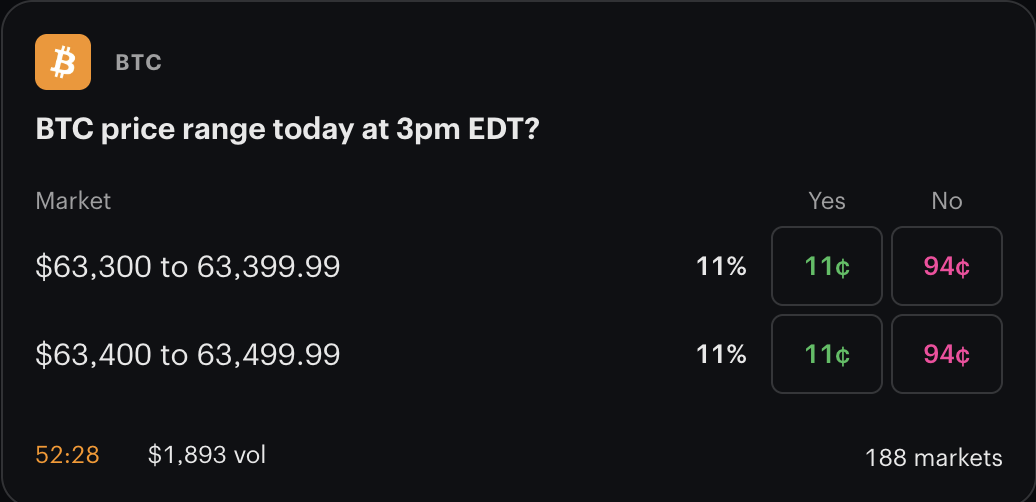
Kalshi’s hourly Bitcoin range markets ask a single question: which price bucket will BTC be sitting in when the hour closes? Strikes are laid out in a ladder of roughly $250 to $500 wide buckets around the current spot, each one a separate yes/no contract that settles at $1 if BTC ends the hour inside the band and $0 if it doesn’t. Because every bucket prices an implicit probability between 1 and 99 cents, the whole strip is essentially a live implied-distribution of where BTC will pin in the next sixty minutes. That makes this market less a directional bet than a volatility instrument — and the cleanest edge belongs to traders who can spot when realized volatility is about to diverge from what the strip is pricing in.
Why Volatility Is the Real Trade
On a quiet hour, BTC tends to chop inside a $200–$400 band, which means the at-the-money bucket on Kalshi will trade somewhere in the 35–55 cent range and the wings will be priced near zero. On a violent hour — a CPI print, an ETF flow headline, a liquidation cascade — BTC can travel $1,500 or more in minutes, and every wing bucket that was 2 cents an hour ago can be the new at-the-money paying out at 50+. The single biggest mistake new traders make on this product is treating it like a coin flip on direction. Direction is noise. The signal is range expansion. If you know vol is about to break out, you don’t need to know which way — you can buy cheap wings on both sides for pennies and let one of them carry the trade.
Watch the Volatility Index Before You Click
Before entering any hourly range trade, pull up a crypto volatility index. Deribit’s DVOL is the most-watched gauge — it’s built the same way as the VIX and reflects 30-day implied vol priced into BTC options, where roughly nine out of ten BTC options globally trade. Volmex’s BVIV is a reasonable alternative. A useful shortcut: divide DVOL by 20 to estimate BTC’s expected daily move in percent. DVOL at 60 implies a 3% daily range; DVOL at 90 implies 4.5%. Convert that to dollars at current spot and compare it to the width of the Kalshi strip. If the implied daily move is materially larger than the strip is pricing across its wings, the wings are cheap. If it’s smaller, the body is cheap and the wings are a fade.
Even more useful than the absolute level is the change. A DVOL that’s been grinding sideways at 45 and suddenly ticks to 52 in fifteen minutes is screaming that options desks are repricing risk — something is coming, even if the news hasn’t hit your feed yet. That is your cue to scan the Kalshi strip for wings that haven’t caught up. The hourly market is slower to reprice than the options book, and that lag is where the edge lives.
A Concrete Setup
Suppose BTC is trading at $95,000, the hour just opened, and the Kalshi strip shows:
-
$94,750–$95,250 (at-the-money) trading at 48 cents
-
$95,250–$95,750 trading at 22 cents
-
$95,750–$96,250 trading at 7 cents
-
$94,250–$94,750 trading at 20 cents, with the next strike below at 6 cents
DVOL was 55 yesterday and is now ticking 61. Funding rates on perps are flipping. There’s an FOMC minutes release in twelve minutes. The strip is pricing a roughly $500–$700 range; the vol index is telling you to expect closer to $1,200. The trade is to buy both 7-cent wings — total cost 14 cents for an asymmetric payout of up to 86 cents if BTC travels into either tail. You are not predicting direction. You are buying a straddle in event-contract form, at a price the strip hasn’t marked up yet.
Buy Quick, Sell Quick
These contracts decay fast. Every minute that passes without movement is gamma bleeding out of your wings — by minute forty of the hour, a wing that didn’t catch a move is going to zero whether or not vol is still elevated. The discipline is: enter early in the hour when the strip is sluggish, take profits aggressively the moment BTC actually moves toward a wing, and don’t marry the trade. If you bought a wing at 7 cents and BTC drives toward it within fifteen minutes, that wing might reprice to 35 or 40 cents before it ever resolves — sell into that move. You’re harvesting the repricing, not waiting for settlement. Settlement is a bonus; the velocity of the reprice is the trade.
The mirror-image trade also works: when DVOL is collapsing, realized volatility has been dead for several hours, and there’s no scheduled catalyst in the hour, the at-the-money body is often underpriced relative to how tightly BTC will actually pin. Selling wings or buying the body becomes the play. Again, take the profit when it appears — don’t hold to expiry hoping for the last few cents.
Bottom Line
The BTC 1-hour range market is one of the cleanest pure-volatility products available to retail traders. Forget which way — ask how far. Anchor every entry to what a real volatility index is telling you, treat the Kalshi strip as a lagging reflection of options-market vol, and trade the repricing rather than the resolution. Get in when vol is about to expand, scale out fast when it does, and accept that the hours you sit out — when DVOL is flat and there’s no catalyst — are part of the strategy, not a failure of it.