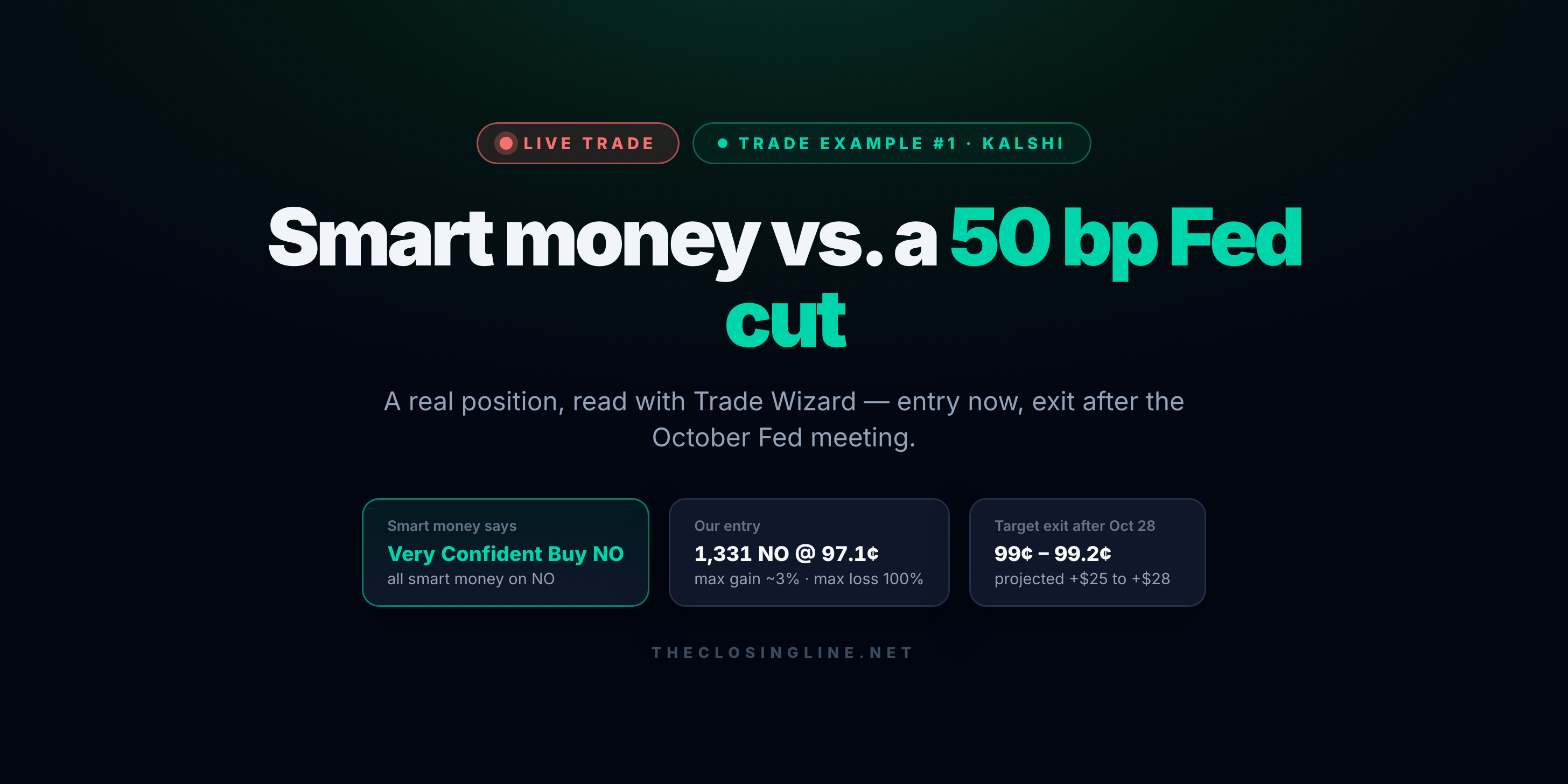
By The Closing Line · Trade Example #1 · Data pulled October 10, 2026
Disclosure: The Closing Line's founder holds 1,331 NO contracts on this market, bought at an average of 97.1¢, and plans to sell after the Federal Reserve's October 27–28 meeting. This is a real position, shared to show how we use our own tools. It is not a recommendation. For entertainment purposes only.
Verify it: this trade, like every trade in our case studies, is posted on The Closing Line's Kalshi profile, TheClosingLine, for transparency.
Trade Examples follow one real Kalshi market from entry to exit, using Trade Wizard to read the smart money along the way. This is the entry. Trade Example #2 will cover the exit and how it turned out.
The market
"Will the Fed cut rates more than 25 bps in 2026?" (Kalshi ticker KXLARGECUT-26)
The market resolves YES if the Federal Reserve makes any single rate cut larger than 25 basis points (a 50 bp cut, for example) before December 31, 2026. Otherwise it resolves NO.
At the time of this snapshot:
| Price | |
|---|---|
| YES bid / ask | 1.4¢ / 3¢ |
| Last trade | 3¢ (YES) |
| NO, bought against the YES bid | about 98.6¢ |
| Open interest | about 222,000 contracts |
In plain terms, the market prices a 50 bp cut this year at roughly 1.5% to 3%. Two Fed meetings remain on the 2026 calendar: October 27–28 and December 8–9.
What the smart money shows
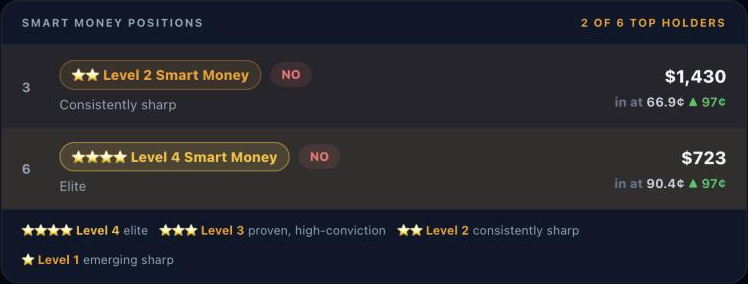
Kalshi lists the largest public positions on this market. Six appeared, worth about $8,970 combined. Trade Wizard profiled each one:
| Position | Who | Size | Avg entry |
|---|---|---|---|
| NO | Level 4 Smart Money | $723 | 90.4¢ |
| NO | Level 2 Smart Money | $1,430 | 66.9¢ |
| NO | Unranked | $2,587 | 94.9¢ |
| NO | Unranked | $1,096 | 85.1¢ |
| YES | Recreational | $2,249 | 14.3¢ |
| YES | Recreational | $884 | 23.2¢ |
Three things stand out:
- All of the smart money is on NO. Two smart-money positions, $2,153 combined, both betting against a large cut. There is no smart money on YES.
- The smart money got in early. Their average NO entry is about 73¢, well below today's ~97¢. They took this side when a big cut looked far more likely than it does now.
- The YES side is recreational money that is deep underwater. Both YES positions were bought at 14–23¢ and are now worth about 3¢.
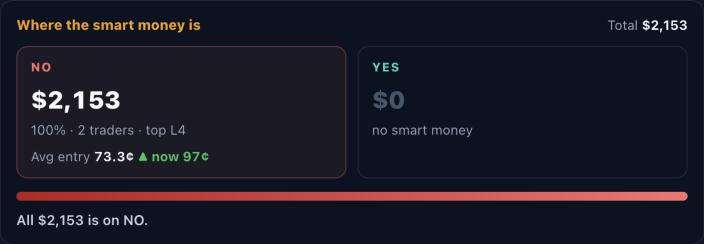
Trade Wizard rolls this into its call:
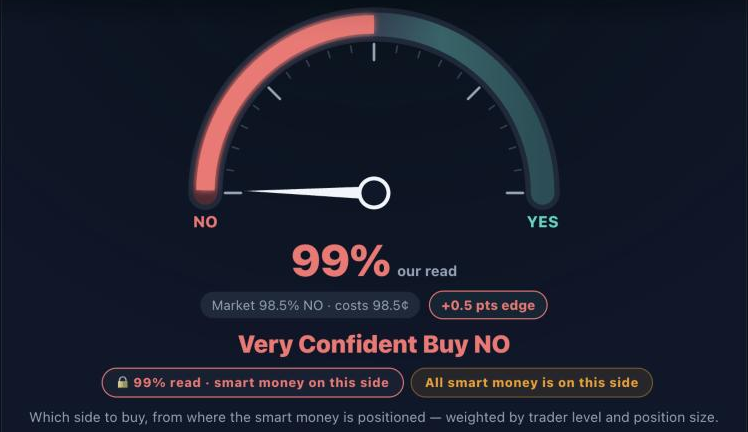
- Smart money says: Buy NO. It is a Very Confident Buy NO, because our read is above 95% with smart money on that side.
- All smart money is on this side.
- Read ~99% vs. a ~98.6% market price, an edge of about half a point.
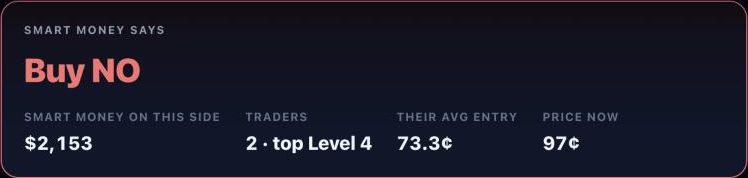
That small edge is the honest part of this example. When a market already prices NO near 99¢, even a unanimous smart-money read can't add much. The read confirms the side; it doesn't promise a big payout.
Following the Level 2 and Level 4 money
The two smart-money positions are the reason for the trade, and they also shaped how big it was.
| Level 2 | Level 4 | Our founder | |
|---|---|---|---|
| Side | NO | NO | NO |
| Avg entry | 66.9¢ | 90.4¢ | 97.1¢ |
| Contracts | about 2,138 | about 800 | 1,331 |
| Money at risk | $1,430 | $723 | about $1,292 |
| Max gain if NO wins | about $708 (49%) | about $77 (11%) | about $39 (3%) |
They're small positions. Together the two smart-money traders have about $2,150 on this market. That is a clear signal about direction, since every smart dollar is on NO, but it's not a large conviction bet by either of them. A Level 4 trader putting $723 on a side tells you which way they lean, not that they'd stake much on it.
So the trade was sized to match. Our founder kept the position at 1,331 NO, about $1,292. That's in the same range as the smart money's own stakes and well below what the two of them hold combined. Following a signal doesn't mean betting more than the people giving it.
They got a much better price. The Level 2 trader bought NO at 66.9¢ and the Level 4 trader at 90.4¢, when a large cut still looked possible. Buying the same side now at 97.1¢ means taking on the same risk, a 50 bp cut, for far less upside: about 3% instead of their 11% to 49%. That's the cost of arriving after the smart money. You can follow their side, but not their price.
The trade
Our founder bought 1,331 NO contracts at an average of 97.1¢, using a limit order that rested on the book and was filled, so the entry paid no fee.
| Cost | about $1,292 |
| Paid out if NO wins at settlement | $1,331 |
| Entry fee | $0 (limit order filled as a maker) |
| Maximum gain, held to the end | about $39 (about 3%) |
| Maximum loss, if the Fed cuts more than 25 bps | about $1,292 |
This is the classic shape of a high-probability NO: a small, likely gain against a large, unlikely loss. One surprise 50 bp cut wipes out the position.
Why the limit order mattered. Kalshi charges a taker fee of 0.07 × contracts × price × (1 − price) when you buy at the market. Taking 1,331 NO at 97.1¢ would have cost about $2.63, close to 7% of the trade's maximum gain. Posting a limit order and waiting to be filled avoided that entirely on this market. The exit can work the same way: a limit sell that rests and gets filled avoids the fee, while selling at the market at 99¢ would cost about $0.93. Our maker vs. taker breakdown explains which markets charge makers too.
The plan: sell after the October meeting
The position doesn't need to be held until January 1, 2027. The plan is to sell after the October 27–28 Fed meeting:
- If the Fed does not cut more than 25 bps in October, only one meeting (December) remains. NO should trade even closer to 100¢, and the position can be closed early. That frees the money instead of tying it up for two more months for the last cent or two.
- If the Fed surprises with a large cut, the position loses. That is the risk being taken.
The target: sell at about 99¢ to 99.2¢, using a limit order again so the exit is fee-free too.
Projected gains
All figures are for 1,331 NO bought at 97.1¢ (cost $1,292.40, no entry fee).
| Exit | Sale proceeds | Projected gain | Return | Days held | Share of max gain |
|---|---|---|---|---|---|
| Sell at 99.0¢ (after Oct 28) | $1,317.69 | +$25.29 | +1.96% | ~19 | 66% |
| Sell at 99.2¢ (after Oct 28) | $1,320.35 | +$27.95 | +2.16% | ~19 | 72% |
| Hold to settlement, NO wins (Jan 1, 2027) | $1,331.00 | +$38.60 | +2.99% | ~83 | 100% |
| Fed cuts more than 25 bps | $0 | −$1,292.40 | −100% | — | — |
What the exit plan buys: selling at 99–99.2¢ collects about two-thirds to three-quarters of the maximum gain in under a quarter of the time. It also takes the December meeting off the table. The last 1¢ or so isn't worth two more months of the same risk.
If the exit has to be a market sell instead of a resting limit order, the taker fee would be about $0.93 at 99¢ (gain +$24.36) or $0.74 at 99.2¢ (gain +$27.21).
What we'll watch before the exit
Using Trade Wizard on this market between now and October 28:
-
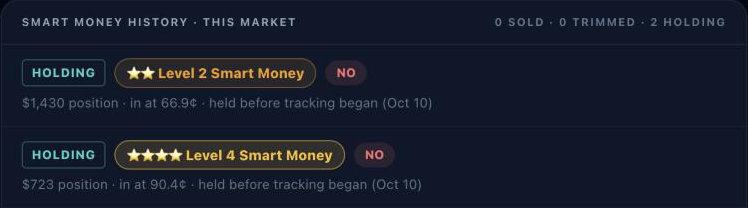
Does the smart money stay? If either smart-money position sells or trims, Trade Wizard's history shows it.
-
Does new smart money arrive, on either side? Any new smart money on YES would be a warning sign. On a market with no smart money yet, Trade Wizard can email you when some arrives.
-
Where does the price sit after the meeting? That decides the exit price.
Coming next: Trade Example #2
After the October meeting we'll publish the exit: the actual sell price against the 99–99.2¢ target, the result after fees, and what the smart money did in the meantime. It will be reported whichever way it goes.
Follow along in Trade Examples, or search this market in Trade Wizard to see the live read. New to reading smart money? Start with How to Find Smart Money on Kalshi.
For entertainment purposes only. Not financial advice. Trading involves risk of loss.
About this case study: Trade Examples are written by The Closing Line using real positions held by our founder, disclosed at the top of each one. Every trade is posted on our Kalshi profile, TheClosingLine, so it can be checked. Trade Wizard and Trade Finder are The Closing Line's own products. Smart Money Levels come from our trader-scoring model; traders are never identified. Questions or corrections.