The first match of the 2026 FIFA World Cup kicked off at 3 PM Eastern today. Mexico vs South Africa, at the Estadio Azteca in Mexico City. The broadcast had been on for about an hour by the time the third million dollars hit Kalshi’s order books on that game alone.
By the time you read this, that number is bigger.
Kalshi is in the middle of the biggest sports event the U.S. prediction market industry has ever seen. The early numbers are already large, and the projections for the next month are enormous. Here’s what’s actually happening with the money.
The headline numbers
A few facts, all confirmed by multiple sources in the last 48 hours:
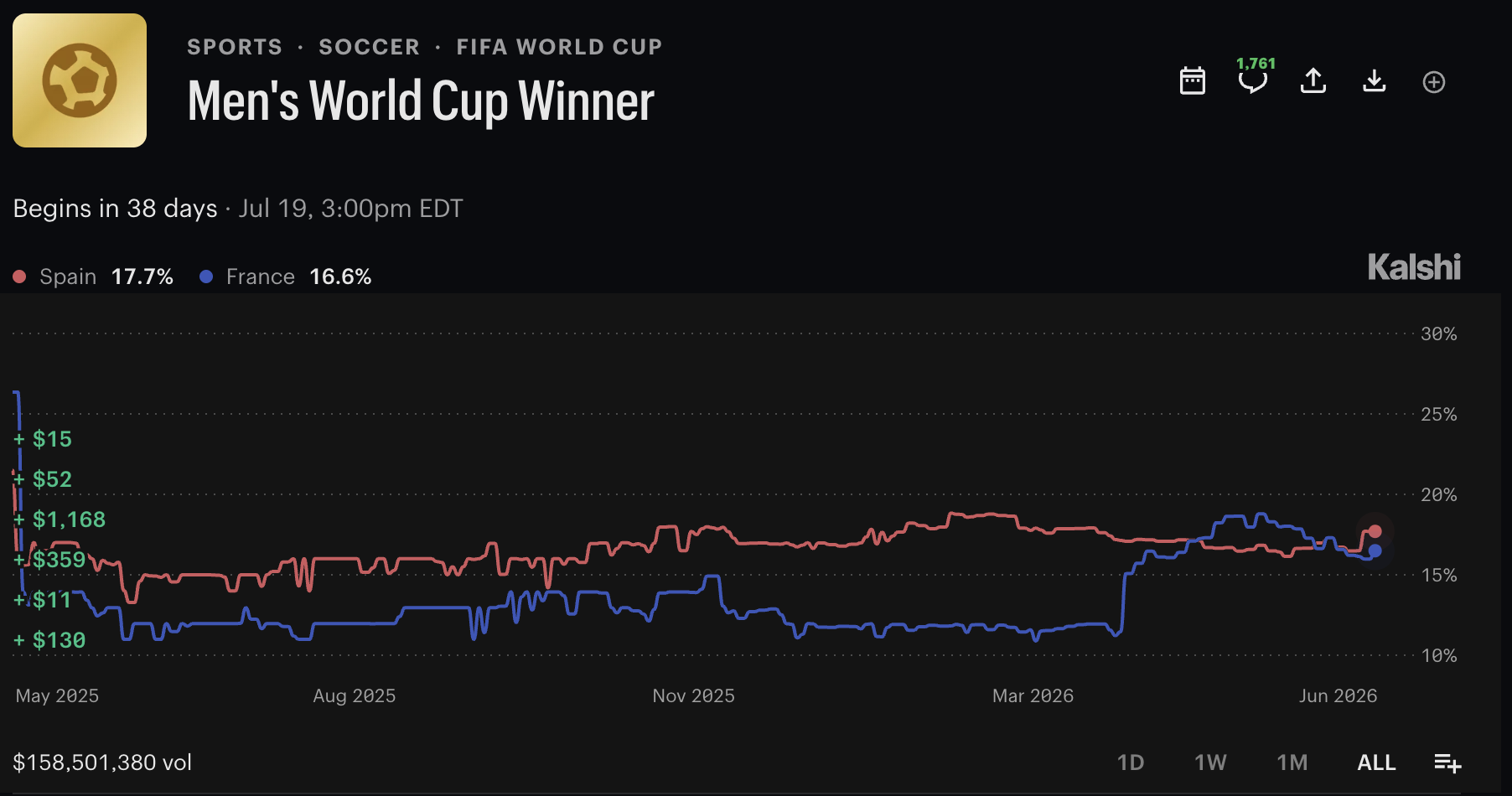
Nearly $150 million has been traded on Kalshi’s World Cup winner market — the contract asking “which country will win the 2026 FIFA World Cup?” Two days ago, that number was $120 million, which already made it the third-largest live market on the entire platform, behind only the 2028 Democratic presidential nominee market ($125M) and the 2026 NBA Finals market ($290M). At the current pace, the World Cup winner market passes the Democratic nominee market this week and starts hunting the NBA Finals.
For context: the winner market opened almost a year ago and has been building volume the whole time. The ~$150 million is the base Kalshi enters the tournament with — group play has barely started.
$3.7 million was traded on the opening Mexico vs South Africa match within hours of trading opening on game day. A single group-stage match moved more money than most Kalshi markets see in their lifetime. Polymarket booked a nearly identical amount on the same game.
$1.47 billion is what analytics firm DeFiRate projects Kalshi will book in total World Cup volume by the time the final whistle blows on July 19. RotoWire’s broader projection covers all U.S. prediction markets combined: $2.37 billion.
If those numbers hit, this single tournament represents roughly 6% of Kalshi’s entire 2025 platform volume ($23.8 billion) — concentrated into 39 days.
How this compares to the Super Bowl
The Super Bowl is the benchmark for U.S. prediction market events. Here’s how the math stacks up:
-
Super Bowl 60 (Feb 2026) on Kalshi: $619.89 million in trading volume
-
Super Bowl 60 across Kalshi + Polymarket combined: $1.38 billion
-
2026 World Cup projected on Kalshi alone: $1.47 billion
-
2026 World Cup projected across all U.S. prediction markets: $2.37 billion
If projections hold, the World Cup will outdraw the Super Bowl by roughly 2-to-1 on Kalshi specifically, and 1.7-to-1 across the industry. That’s not a small shift — it’s a fundamental restructuring of what the biggest event on the calendar looks like for U.S. prediction markets.
A few reasons the World Cup has structural advantages over the Super Bowl as a prediction market event:
1. More games. The Super Bowl is one game. The World Cup is 104 games across 39 days, each with its own moneyline, totals, and prop markets. Every game is a new trading opportunity.
2. Longer duration. A single Super Bowl Sunday is one big spike in volume. The World Cup is a steady drip every day for over a month, with progressively higher-stakes games as the bracket narrows. Volume compounds.
3. Broader audience. Soccer is a global sport with massive immigrant communities in the U.S. who follow specific national teams obsessively. The World Cup pulls in trading interest from communities that don’t normally engage with U.S. sports.
4. The winner market builds for a year. Super Bowl champion markets only start trading in earnest a few months out. The World Cup winner market has been live since last July, accumulating volume the entire time.
The most popular trades right now
Enough macro. Here’s what people are actually buying, with live prices from opening day:
The patriotic trade: USA to win the World Cup. This is the single most revealing data point of the tournament so far. On Polymarket’s winner market, the country with the most money traded on it is not Spain or France — it’s the United States, with almost $57 million in volume, despite the U.S. carrying a single-digit implied probability of actually winning. American traders are betting on America at rates far beyond what the team’s odds justify. (If you read our piece on the Kalshi $1M contest, you’ll recognize this as exactly the pick-distribution distortion we predicted — patriotic money piles onto the home team regardless of price.)
The favorites trade: Spain and France at the top. Spain’s YES contract trades at 16.5¢, France at 16.3¢ — a statistical coin flip for the favorite tag. Traditional sportsbooks agree: Spain at +450 to +480 across DraftKings, FanDuel, and BetMGM, France right behind. Roughly 70% of the winner market’s implied probability sits in just five teams (Spain, France, Brazil, Argentina, England). The other 43 teams split the remaining ~30%.
The opening-match favorite: Mexico at 70¢. Traders piled into Mexico to beat South Africa at 70 cents per contract — a 70% implied probability for the host nation at the Azteca. The more aggressive version of the same conviction: Mexico to win by more than 1.5 goals at 44¢, for traders who think the host doesn’t just win but rolls.
The USA opener: tonight’s volume magnet. The U.S. plays Paraguay tomorrow night (June 12, 9 PM ET at SoFi Stadium) in its first home-soil World Cup match since 1994. Kalshi’s pricing as of this morning: USA to win in regulation at 50¢, Paraguay at 24¢, the draw at 28¢. If the patriotic-money pattern holds, expect heavy one-sided flow on the USA side and this match to challenge the Mexico opener’s volume record.
The Golden Boot props. Kylian Mbappé is the 16¢ favorite for tournament top scorer, with Harry Kane drawing real volume behind him. The retail-favorite longshot: Lionel Messi at 5¢ — a price that’s almost certainly more about sentiment than scoring projections, which is exactly the kind of contract casual money loves.
The market-mechanics trades. Beyond picking winners, the granular stuff is live: over 2.5 goals in South Korea vs Czechia at 43¢, both teams to score in Mexico vs South Africa at 38¢, plus first-half lines, team totals, and alternative spreads on every match. This is sportsbook-grade depth — the product surface area that simply didn’t exist on prediction markets a year ago.
What the $1 million contest is actually doing
Kalshi is also running a free contest awarding $1 million split among everyone who correctly picks the tournament winner before today’s deadline. Entry was free, no deposit required.
The contest is doing two things:
1. Mass user acquisition. Every contest entry requires a verified Kalshi account with KYC completed. The contest converts curious sports fans into verified Kalshi users in one tap. Those users are then primed to trade once the in-app markets come alive.
2. Subsidizing volume. The million-dollar prize pool is a customer acquisition cost. If the projections are right and Kalshi books $1.47 billion in tournament volume, the $1M contest will look like the best marketing dollar ever spent.
The bigger picture for prediction markets
Step back from the World Cup specifically and look at what’s happening in the industry:
-
Kalshi processed $23.8 billion in 2025, up over 1,100% year-over-year
-
The platform handled 97 million transactions in 2025, up over 1,680% from 2024
-
January 1, 2026 daily volume: $291 million — roughly double December’s pace
-
Sports now routinely accounts for more than 80% of all Kalshi trading volume in a given week — rising above 90% on weekends
A year ago, “prediction markets” was a niche product mostly used by political junkies and a small group of professional traders. Today, it’s a $23 billion annual industry where a single group-stage soccer match moves $3.7 million before dinner.
The World Cup is the tournament where that shift becomes undeniable.
What to actually watch
A few things worth tracking as the tournament progresses, beyond just the scores:
1. Winner market volume at the knockout round. A market does its biggest trading right before resolution. When the bracket narrows in late June, expect the winner market to accelerate from ~$150M toward $500M-plus.
2. Game-day volume curves. $3.7 million on the Mexico opener is one data point. The telling number is average per-match volume across the group stage. If it averages $5M+ per game, Kalshi is on track for the $1.47B projection.
3. The USA-Paraguay number. Tomorrow night’s match is the first real test of the patriotic-money thesis. If a U.S. home opener at SoFi Stadium moves several times the Mexico match volume, the rest of the tournament’s projections get revised upward.
4. Final volume vs. Super Bowl volume. The single biggest volume day will be the final, July 19, at MetLife Stadium. If that day moves more than the Super Bowl did, the prediction market industry has officially completed its takeover of “biggest U.S. betting event.”
The tournament has been going for a few hours as of this writing. By tomorrow morning, the numbers will be bigger. By July 19, we’ll know whether the projections held.
For now: ~$150 million on the winner. $3.7 million on the opener. $57 million of pure patriotism on Team USA. The math just keeps going up.