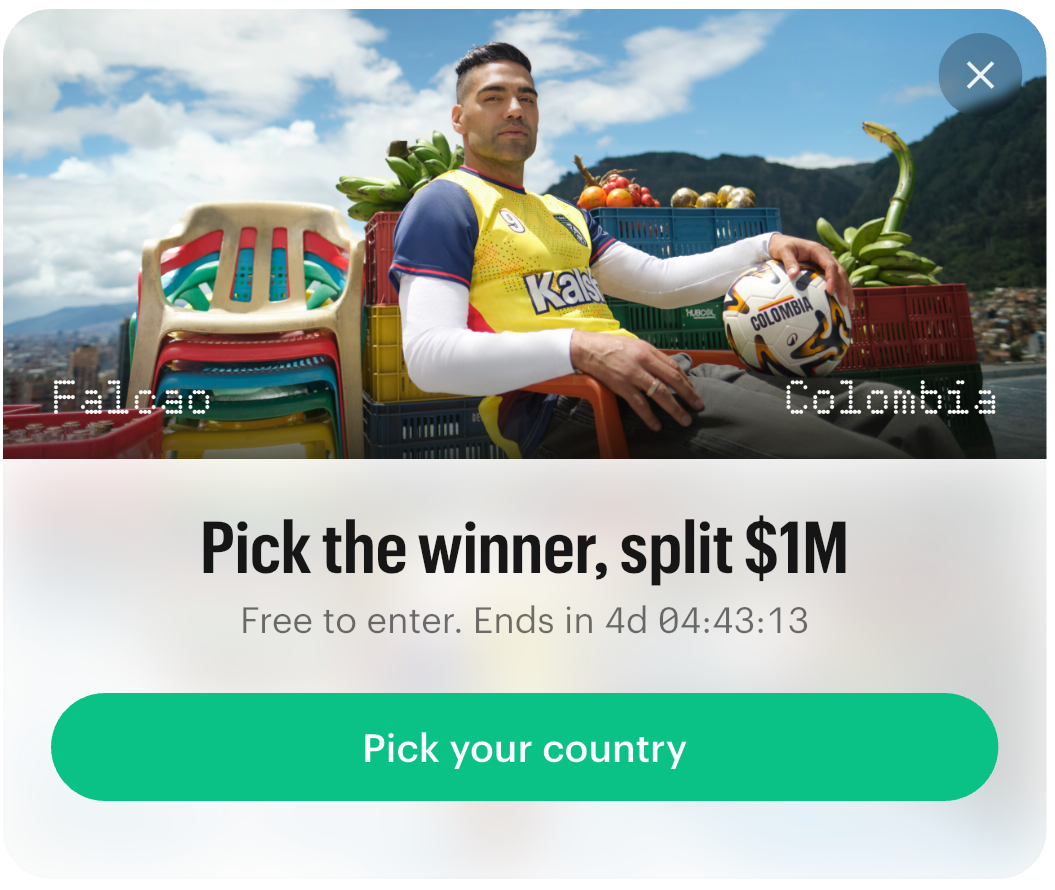
Kalshi is doing a thing this week, and most of the coverage is missing the actual game inside it.
The pitch is simple. Free contest. Pick which country wins the 2026 FIFA World Cup. If you get it right, you split $1 million with everyone else who also got it right. Entry costs nothing — no deposit, no trade, just a verified Kalshi account. The window is open now and closes June 11 at 3 PM EDT, just before the tournament kicks off.
Bonus: every entry also goes into a separate drawing for two tickets to the World Cup Final, reimbursed up to $35,000 through FIFA’s official channels (or $10,000 cash if the tickets fall through). That part is pure random luck. The $1 million part is not.
The $1 million part is a math problem disguised as a soccer contest. Here’s why.
The math nobody’s mentioning When a contest splits a fixed prize pool equally among everyone who picks correctly, you’re not just trying to pick the winner. You’re trying to pick the winner that fewer other people pick.
Look at the extremes:
You pick France. France wins. So did 200,000 other people. Your share of the $1M prize pool: $5.
You pick Morocco. Morocco wins. So did 500 other people. Your share: $2,000.
Both outcomes require you to be right. But the financial difference is 400 to 1.
The technical name for this kind of contest is pari-mutuel. It’s the same structure horse tracks use to pay out — the more money on a horse, the smaller each ticket’s share gets. And it has one consistent feature, mathematically proven for a century: the optimal bet is almost never the favorite.
Why the crowd will overpick the favorites This is where it gets interesting. The crowd in a contest like this is going to do something predictable: they’ll pick France, Spain, Brazil, England, and Argentina — the five teams everyone is talking about — at rates higher than the actual probability that those teams win.
This isn’t a guess. The Becker study on Kalshi I covered a few weeks back showed exactly this pattern in 72 million real trades: people overpay for the obvious, the dramatic, the favorites. It’s called the longshot trap in normal markets — paying too much for a favorite to “lock in a sure thing.”
In a contest like this, the longshot trap flips. The overpicked favorites are now the bad pick, because their prize pool gets diluted across thousands of identical picks. The teams that win the contest are the ones where:
Probability of winning > Share of entries picking them
If France has a 15% chance to win but 25% of entries pick France, your math says don’t pick France.
If Portugal has a 7% chance to win but only 3% of entries pick Portugal, your math says strongly consider Portugal.
The metric to look at is probability ÷ pick share. Higher number = better contest pick. The favorites lose this ratio. The serious-but-not-obvious contenders win it.
What the live odds actually say As of this past week, Kalshi’s own World Cup champion market is showing rough implied probabilities like this (these will move; check before you pick):
Spain — around 22%
France — around 18%
Brazil — around 15%
Argentina — around 12%
England — around 10%
Portugal — around 7%
Germany — around 6%
Netherlands — around 5%
Everyone else combined — around 5%
Now look at what’s likely to happen in the contest. The casual fans entering for free, picking once, never to change — most of them will pick the country they hear about the most. That means Spain, France, and Brazil will be massively overpicked. Probably 60-70% of all entries combined, despite representing only about 55% of the true probability.
Meanwhile, Portugal at 7%, Germany at 6%, Netherlands at 5% — these are real contenders. They’re not winning the contest of “who does Joe in Phoenix pick after thinking about it for 30 seconds.” But they’re winning the contest of “if this team wins the actual World Cup, how big is your slice of the million dollars.”
The most underrated names If I had to rank picks strictly by expected value (probability divided by likely contest share), without any soccer takes layered on:
The strongest plays are second-tier contenders that casual fans don’t pick:
Portugal — strong squad, ~7% odds, probably gets less than 4% of contest picks
Germany — historical heavyweight that’s currently out of fashion
Netherlands — perennial contender, rarely the casual pick
The medium plays are upper-tier teams that the public picks but not overwhelmingly:
Argentina — defending champion but the casual pick has moved to Spain
England — strong on paper, but English fans living in the US split the pick
The plays I’d avoid:
Spain — probably the most-picked country in the contest, even though it’s the favorite. The dilution will be brutal.
France — second-most-picked, similar story.
The U.S. — patriotic picks will pile up here, despite a roughly 1% real chance of winning.
The longshot trap (do not fall for this):
Pure dart-throws like Croatia, Belgium, or any sub-2% team. Yes, your share would be enormous if they won, but the probability is too low. Picking Belgium at maybe 1.5% to win the actual tournament, even if you’d be the only person picking them, only gives you an expected value of about $15,000 × 1.5% = $225. That sounds great, but it’s worse than picking Portugal at 7% with a 3% contest share, which gives you roughly 0.07 × ($1M / (0.03 × entries)) — even with 100,000 entries, that’s $2,300 expected. Real probability beats fantasy share.
The actual play Pick a team with at least 5% real probability of winning, that’s unlikely to be in the casual top 3.
My top pick by pure math: Portugal.
Real contender, world-class roster, won the Nations League last year, and crucially — not the team most Americans will instinctively pick. The combination of decent winning probability and likely-underpicked contest share is the highest-EV slot in the field.
If you don’t love Portugal, Germany or Netherlands offer similar profiles. If you want a bigger swing, look at Belgium or Croatia — but understand you’re sacrificing real probability for crowd-share math, and the trade usually doesn’t work.
The fine print A few things to know before you enter:
The contest is not available in New York or Florida. Kalshi’s geofencing rules.
You must be 18 or older and complete KYC verification.
You only get one pick, and once submitted, it cannot be changed.
If no one picks the actual winner, the prize pool is not awarded. So if Morocco shocks the world and nobody bet on them, the $1M just doesn’t get paid out. This is rare but possible.
Entry closes June 11 at 3 PM EDT. The tournament kicks off the same day.
That last detail matters. The contest is free, but it’s a one-shot bet with a deadline. Don’t overthink it past Sunday night.
The bigger picture Kalshi giving away a million dollars for a free contest is the kind of marketing move you do when you’re trying to onboard hundreds of thousands of new users in a single week. By every public estimate, prediction markets are going to clear $2.5 billion in trading on the 2026 World Cup, with somewhere between $1.5 and $2 billion of that going through Kalshi alone.
The contest is the funnel. Get people verified, get them in the app, get them ready to trade actual contracts on group stage games once the tournament starts. The $1M is a customer acquisition cost.
That’s not a knock on the contest. It just means you should take the free EV when it’s offered. The contest is genuinely positive expected value if you enter at all, and significantly more positive if you pick the right country.
Don’t pick Spain. Don’t pick France. Pick Portugal.
Entries close Wednesday at 3 PM EDT. If you’ve been on the fence about getting verified on Kalshi anyway — for the perps coverage, the combos, the prediction market work — this is the cheapest possible reason to do it. Free, with upside.