In the OddsJam piece I laid out the basic idea: sharp bettors set traps on exchanges, and the smart play is to read what they actually want and take that side. This is the deeper version — the actual playbook for identifying high-conviction sharp plays, the specific thresholds that separate signal from noise, and how to turn all of it into a bet at a better price than the sharps themselves are getting.
None of this requires you to be sharp. It requires you to read the sharps. Here’s how.
Why the pros are on exchanges in the first place
Start with a problem most amateurs never think about: winning bettors get kicked out of sportsbooks. Traditional books — DraftKings, FanDuel, the rest — are built for recreational money. The moment you consistently beat them, they limit your bets to pennies or close your account outright. That’s not a conspiracy theory; it’s the documented business model.
So the real pros migrate to betting exchanges — platforms like Novig and Profitex — where the model is different. On an exchange, you’re not betting against the house; you’re betting against another user. That means no limits on winners, but it also means every bet needs a counterparty — someone willing to take the other side. And that structural fact is the entire key to reading sharp money, because to get their bet filled, a sharp has to post it where you can see it.
Liquidity as bait: the core mechanic
Here’s the insight that makes the whole strategy work.
When a sharp bettor wants a position on an exchange, they post liquidity — an offer at a price, waiting for someone to take the other side. When you see a large amount of money (say $10,000) sitting on one side of a player prop, the instinct is to think “the sharps are betting that side.”
It’s the opposite. That liquidity is bait. The sharp posting $10,000 on the Over isn’t trying to bet the Over — they’re trying to get you to take the Over, so they can have the Under at that price. The side where the money is posted is the side they want you to take. The side they actually want is the inverse.
So the first rule of reading sharp money on an exchange: the liquidity shows you the trap, not the target. Heavy money hosted on the Over means the sharps want the Under. Flip whatever you see.
The thresholds that separate signal from noise
Not every posted number means something. The skill is knowing which liquidity is a genuine sharp signal and which is just noise. A few thresholds worth watching:
$500+ on a player prop is meaningful. Liquidity thresholds aren’t uniform across bet types. On a moneyline — a big, liquid, heavily-traded market — it takes a lot of money to signal anything, because large sums flow through those markets constantly. But on a player prop, which is a thinner, more specialized market, $500 or more of liquidity is a real signal. Props are priced off projection models, and a sharp willing to post serious money on one is expressing unusual confidence in their number. On props, $500 punches above its weight.
Compare exchange liquidity to Pinnacle’s limits. Pinnacle is widely considered the sharpest sportsbook in the world — it welcomes winning bettors instead of banning them, and sets its limits accordingly. So Pinnacle’s limit on a market — how much it’s willing to take — is a useful yardstick for how big the sharp money could be. The tool shows this as the “P Limit.” The signal isn’t just the raw liquidity number; it’s the ratio of liquidity to the Pinnacle limit. Liquidity pressing up against — or exceeding — Pinnacle’s limit is a tell of extreme conviction: the sharps want more action than even the sharpest book in the world would take. Liquidity sitting comfortably below the limit is a softer signal — real, but not a table-pounder.
Conviction stacks. The strongest signals are the ones where multiple indicators line up — a prop with well over $500 in liquidity, liquidity close to or above the Pinnacle limit, hosted early rather than late. One indicator is a lead. Several pointing the same way is a high-conviction play.
A real example: Belgium vs. Senegal, decoded
Let’s read an actual market off the tool, because the numbers teach the method better than any abstract rule.
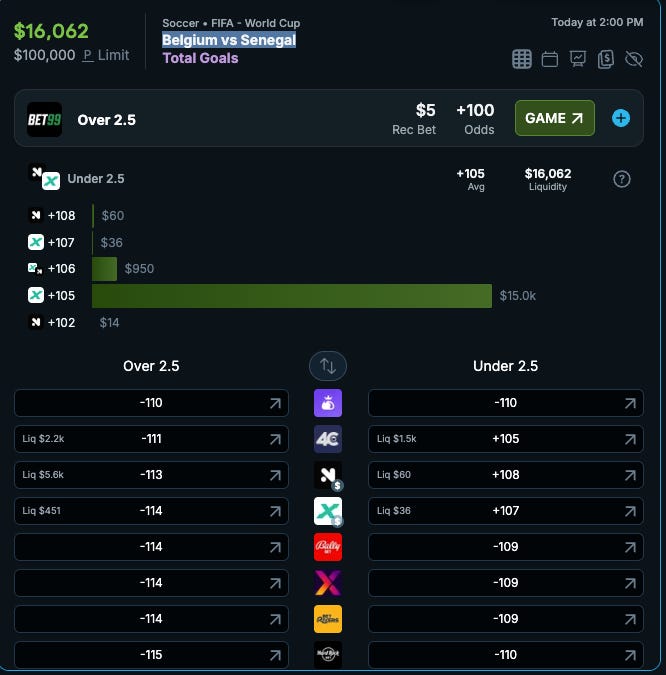
Here’s a World Cup match — Belgium vs. Senegal, Total Goals, Over/Under 2.5:
-
Over 2.5 goals: a $5 “Rec Bet” at +100 — the recreational money, a tiny casual flyer.
-
Under 2.5 goals: $16,062 in liquidity hosted at +106 — the sharp money.
-
P Limit: $100,000 — what Pinnacle would take on this market.
Now decode it step by step.
Step one — invert the liquidity. The $16K is hosted on the Under. Remember the bait rule: the side the money is posted on is the side they want you to take. So the sharps are hosting the Under to bait Overs — meaning the side they actually want is the Under at +106 or better. (On a total, the mechanics are the same as any prop: heavy hosted liquidity on one side points to conviction on that side being the value once you shop the price.)
Step two — check the conviction against the P Limit. This is where the screenshot gets honest. Yes, $16,062 is real money. But Pinnacle would take $100,000 on this same market — so the sharp liquidity here is only about 16% of what the sharpest book in the world would accept. That’s a moderate signal, not a table-pounder. Compare it to a moneyline elsewhere on the same board where the liquidity ($18,447) sat almost exactly at its limit ($18,450) — liquidity maxing out the limit is a much louder signal than liquidity sitting at 16% of it.
So the honest read on Belgium/Senegal isn’t “hammer the Under.” It’s: “there’s a real sharp lean toward the Under, but the conviction is moderate — the money hasn’t come close to filling what Pinnacle would allow.” That nuance is the difference between a disciplined bettor and someone who just bets every green number they see.
Step three — shop the price. If you do want the Under, the tool’s whole payoff is the price comparison grid: it scans the retail books and shows you where the Under 2.5 is available — some books at +105, +107, +108 — so you can take the sharps’ side at a better number than the +106 on the exchange. Same side the sharp wants, better price than the sharp is getting.
That’s the method in miniature: invert the liquidity, weigh it against the Pinnacle limit, then beat the price at retail.
The payoff: scan for a better price than the sharp
Here’s the part that turns reading sharp money into an actual edge, and it’s the step most people miss.
Once you’ve identified what the sharp actually wants — say, the Under on a player’s points prop — you don’t just take it on the exchange at their price. You scan the retail books to find that same side at a better price. Because sportsbooks price independently and lag each other, one of them — a Hard Rock, a SportzIno, whoever — is often offering the Under at a number better than the exchange’s implied line.
Think about what that means. The sharp did the modeling. The sharp expressed the conviction. The sharp took on the work of finding the edge. And you get to take the exact same side they want, at a price even better than they’re getting — because you shopped for it. You’re not just following the smart money; you’re front-running it to the best available number.
That’s the whole play, in four steps:
-
Spot the liquidity — heavy money posted on one side of a prop on an exchange.
-
Invert it — the side they’re hosting is bait; the side they want is the opposite.
-
Confirm the conviction — $500+ on a prop, exceeding Pinnacle’s limits, the signal is real.
-
Beat the price — scan retail books for that same side at a better number, and take it there.
A one-click tool that navigates you straight to the book with the best price turns that final step from a manual chore into a tap — which matters, because these edges close fast.
Why this connects to everything we write about
If this feels familiar, it should. It’s the same core idea that runs through this whole publication, just applied to sportsbooks instead of Kalshi.
It’s the maker/taker dynamic: the sharp posting liquidity is the maker, and the recreational bettor hitting it is the taker — except here you’re learning to read the maker’s intent and side with it. It’s the convergence idea: exchange prices (fast, sharp) and retail prices (slower) disagree, and you profit from the gap. And it’s the same thing our own scanner does for Kalshi versus the sportsbooks — surface where the sharp number and the available number diverge, so you can take the better side.
Sharp money isn’t magic. It’s just information, and the pros can’t fully hide it because the exchange structure forces them to show their hand. Learn to read it, and you’re no longer the amateur taking the bait — you’re the one reading the trap and stepping around it.
The honest limits
Now the part the strategy videos skip.
Following sharp money is not a guarantee. Sharps are right more often than the public — that’s what makes them sharp — but “more often” is not “always.” You will follow high-conviction plays that lose, and you’ll lose plenty of them. The edge is real over a large sample, not on any single prop. If you can’t stomach a cold streak, this isn’t for you.
Reading the liquidity correctly is harder than it sounds. Not every big number is a sharp’s bait — sometimes it’s just another recreational whale, or a stale order, or a market maker hedging. The $500-and-Pinnacle heuristics help filter, but they don’t make the read foolproof. Misreading which side is the trap flips your edge into a leak.
The best prices vanish fast, and the books that offer them limit winners too. The retail book with the juicy off-market number is often the one quickest to limit you once you start beating it. Advantage betting is a permanent cat-and-mouse game with the books, and that friction is a real cost, not a footnote.
This is a volume game. Any single edge here is small. The strategy only pays if you’re placing a lot of these bets, tracking closing line value, and grinding out the sample. It rewards discipline and record-keeping, not vibes.
The takeaway
The pros left the retail books because they win, and on exchanges they can’t win without showing you where they’re positioned. That’s the crack in the wall. Read the posted liquidity as bait, invert it to find the side they actually want, confirm the conviction with the $500-prop and Pinnacle-limit checks, then shop the retail books for a price even better than the sharps are getting.
You don’t have to build the model. You just have to read the people who did — and be disciplined enough to follow them to the best number, over and over, through the losses as well as the wins.
Sharp money leaves footprints. This is how you follow them. Sign Up Now
This piece describes a strategy for reading exchange liquidity as a proxy for sharp positioning; it is educational, not a guarantee of profit. The Belgium vs. Senegal figures ($16,062 liquidity on Under 2.5 vs. a $100,000 Pinnacle limit, with retail prices around +105 to +108) are from a single live screenshot and reflect one moment in a constantly-moving market. “P Limit” refers to Pinnacle’s limit on that market, used as a conviction yardstick — liquidity far below the limit (as in this example, ~16%) is a moderate signal, not a strong one. Following sharp money loses on many individual bets and only carries an edge across a large, disciplined sample. Liquidity signals can be misread, best prices close quickly, and sportsbooks limit or close winning accounts. Thresholds cited ($500+ on props, Pinnacle-limit comparisons) are heuristics used by advantage bettors, not exact rules. If any tool links in this article are affiliate links, the author may earn a commission. Nothing here is betting advice.