Most “follow the smart money” products are vague to the point of uselessness. They flash a percentage, tell you “73% of sharp money is on the Yankees,” and leave you to take it on faith. OddsJam’s Sharp Money tool does something more specific and, once you understand it, more clever. It’s not really showing you where the money is — it’s showing you a trap the pros are setting, and pointing you to the other side of it.
Think of it in casino terms. At a casino, the house sets the prices, the average player — the Joe — takes them, and over time the house collects. Sports betting has its own version of the house: the pros, the sharp bettors who set prices on exchanges and wait for recreational money to take the bad side. Most bettors are the Joe, walking up and taking whatever number is offered. This tool is about flipping that — reading what the pro money is doing and standing on its side of the table instead of the Joe’s.
Let me decode it using a real example off the tool.
The TJ Friedl example, decoded
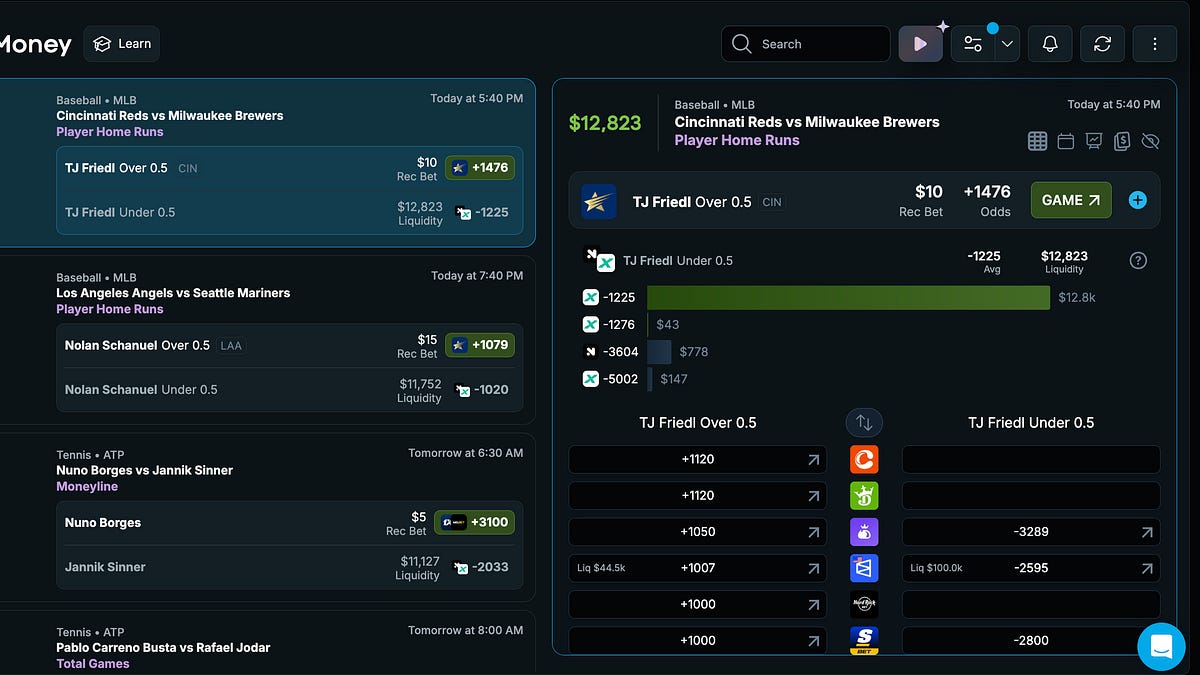
Here’s a market the tool flagged: Cincinnati Reds vs. Milwaukee Brewers, player home runs, TJ Friedl. Two numbers sat side by side:
-
TJ Friedl Over 0.5 home runs: a $10 “Rec Bet” at +1476
-
TJ Friedl Under 0.5 home runs: $12,823 in “Liquidity” at −1225
The headline number — $12,823 — is the sharp liquidity. The $10 is the recreational money. At first glance you might read it as “the sharps are betting almost $13K on Friedl not homering.” But that’s not quite what’s happening, and the distinction is the entire insight.
Open the detail view and you can see exactly where that liquidity sits. The bulk of it — about $12.8K — is hosted on the Under at −1225 on an exchange (ProphetX), with smaller amounts scattered across other exchanges (Novig at −3604 holding $778, and a couple more). That’s a wall of money offering the Under.
The “crossed market” trick
Here’s the mechanism. On a betting exchange (peer-to-peer, where users set their own prices rather than taking a book’s line), sharp bettors don’t just place bets — they host them. They post a price and wait for someone to take the other side.
OddsJam’s key observation: when a sharp posts heavy liquidity on one side, the side they actually want is the opposite one. They’re putting up the Under at −1225 not because they’re desperate to bet the Under, but because they’re hoping a recreational bettor wanders in and takes the juicy-looking Over at +1476. The sharp is making the market — setting a trap — and the side they’re hoping you don’t notice is the one they’re really angling for.
So the tool reads the liquidity, infers what the sharps genuinely want (the Over), and then does the valuable part: it scans every other sportsbook to find you that same bet at a better price. Look at the bottom of the Friedl detail view and you can see it working — the Over is available across retail books at +1120 (Caesars and DraftKings), +1050, +1007, and +1000. The sharp-implied fair price on the Over is roughly +1225 (the mirror of the −1225 they’re laying on the Under), so grabbing the Over at +1120 is taking the side the sharps want, at a price in their ballpark — instead of being the sucker who took their +1476 Over bait without shopping for the better number.
OddsJam calls this a “crossed market”: when the price sharp money implies on an exchange lines up with — or beats — a price you can actually get at a retail book, you have a bet the pros effectively endorse, available to you at a number they’d happily take.
In their own words, the logic runs like this: if there’s heavy liquidity on an Under at +121 on an exchange, that means sharps actually want the Over at −121 or better. The tool then finds you the Over at, say, −115 at a retail book — the same side the sharps want, at a price even better than what they’re working with. You’re following the smart money instead of being the amateur who took their bait.
A second example: Nolan Schanuel
The tool flags these all day across the board. Same screenshot, next market down: Angels vs. Mariners, player home runs, Nolan Schanuel.
-
Schanuel Over 0.5: a $15 rec bet at +1079
-
Schanuel Under 0.5: $11,752 in liquidity at −1020
Identical shape to the Friedl market: a tiny recreational flyer on the Over, and nearly $12K of sharp money hosting the Under — which, decoded, means the sharps want the Schanuel Over at around +1020 or better, and the tool’s job is to find you that Over at the best retail price available. Once you learn to read the pattern — small rec money on one side, a wall of exchange liquidity on the other — you see the same structure repeat across every sport on the board (the same screenshot had a Borges–Sinner tennis market doing the exact same thing).
Why this works (when it works)
The reason this has teeth comes down to who is on each side and why exchange liquidity is informative.
Sharps post prices; recreational bettors take them. On an exchange, the person hosting a large resting order is, by definition, the one with a model and a price they believe in. They’re not chasing — they’re quoting. That makes hosted liquidity a cleaner signal of informed opinion than raw bet counts, which are dominated by small public money.
It’s the maker/taker dynamic, applied as a signal. We’ve written before about how, on any exchange, the patient party posting orders (the maker) tends to have the edge over the impatient party hitting them (the taker). OddsJam’s Sharp Money tool is essentially a way to read the makers — to see what the sharp, price-setting side is positioned for — and then route you to the best available version of that same position. You’re not just guessing who’s smart; you’re reading where the smart, price-making money sits.
The benchmark is sharp, not public. OddsJam builds its fair-value reference off sharp books and exchanges (think Pinnacle, Circa, and peer-to-peer liquidity) rather than the recreational books where the public piles in. That’s the right reference. The sharp price is the closest thing to a “true” probability, and any retail book offering a number better than it is, by definition, handing you value.
How you’d actually use it
The workflow is built to be fast:
-
The tool flags a crossed market — a spot where sharp liquidity implies a price you can beat at a retail book.
-
It tells you the side the sharps actually want (the opposite of the side they’re hosting).
-
It points you to the book and price where you can take that same side, at equal or better odds.
-
A one-click bet feature takes you straight to the market so you can place it before the gap closes.
The speed matters, because these edges don’t last — the moment retail books catch up to the sharp price, the crossed market closes. (If that “fast markets close, slow markets linger” idea sounds familiar, it’s the same convergence principle we keep coming back to — OddsJam is just automating the detection across sportsbooks.)
The honest limits
Now the part an affiliate is supposed to skip — which is exactly why I won’t.
It’s a paid tool, and it’s priced for volume. OddsJam’s Sharp Money plan and the higher Platinum tier aren’t cheap, and the honest math is that the subscription only pays off if you’re betting real volume across multiple books. If you’re putting $20 a week on parlays for fun, the cost will eat any edge the tool finds. It’s built for people treating betting as a numbers game, not a hobby.
The edge requires discipline and a thick skin for variance. Following sharp money is a long-run, large-sample strategy. You will take “correct” bets that lose — plenty of them. The value is in the price you got, not the result of any single bet, and most people aren’t wired to keep firing after a cold streak.
Books limit winners. This is the uncomfortable truth across the whole advantage-betting world: if you consistently beat retail sportsbooks, they will limit or close your accounts. Tools like this can accelerate that. Winning bettors end up playing a cat-and-mouse game with the books, and that’s a real cost of the strategy, not a footnote.
Not every flagged play is gold. Some users report that a chunk of flagged edges shrink or vanish after you bet — a single book posting an outlier number that then “corrects” to the consensus, leaving you with no real value. The tool is reading a snapshot; the market moves. Treat a flag as a strong lead to verify, not an automatic green light.
It’s a different game than Kalshi. OddsJam lives in the traditional-sportsbook world. The skills overlap with prediction-market trading — reading sharp money, hunting price gaps, thinking in fair value — but it’s a separate ecosystem with its own quirks (account limits, book-by-book line shopping) that don’t map one-to-one onto a Kalshi-style exchange.
The takeaway
OddsJam’s Sharp Money tool is genuinely clever because it doesn’t just point at big money and say “follow it.” It reads the structure of an exchange — who’s posting prices versus who’s taking them — infers what the price-setting sharps actually want, and routes you to the best available version of that bet before the market catches up. That’s a real, defensible edge for the right user.
The “right user” is the catch. If you bet serious volume, shop multiple books, and can stomach variance and account limits, it’s one of the sharpest tools on the market and well worth a look. If you’re a casual bettor, the subscription will likely cost more than the edge returns. Know which one you are before you pay.
If you want to try it, there’s a free trial, and you can check it out through my affiliate link. Either way — read the limits above first. That’s the part the other affiliates won’t tell you.
Affiliate disclosure: The author is an OddsJam affiliate and may earn a commission from sign-ups through provided links. Tool mechanics described per OddsJam’s published methodology and third-party reviews (RotoWire, others) as of mid-2026; the TJ Friedl and Nolan Schanuel figures are from a single live screenshot (June 30, 2026) and reflect one moment in a constantly-moving market — the cross-book prices shown will have changed. Pricing, tiers, and features change — verify current details on OddsJam directly. Advantage betting carries real risk: most bettors lose long-term, sharp edges require volume and discipline to realize, individual bets frequently lose, and sportsbooks limit winning accounts. Nothing here is betting advice.